
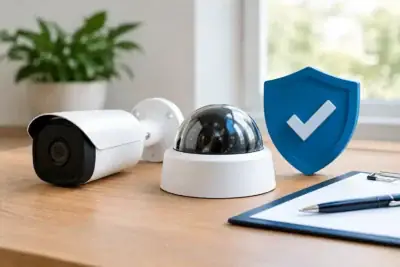
PTZ Versus Fixed Security Cameras: Which Fits?
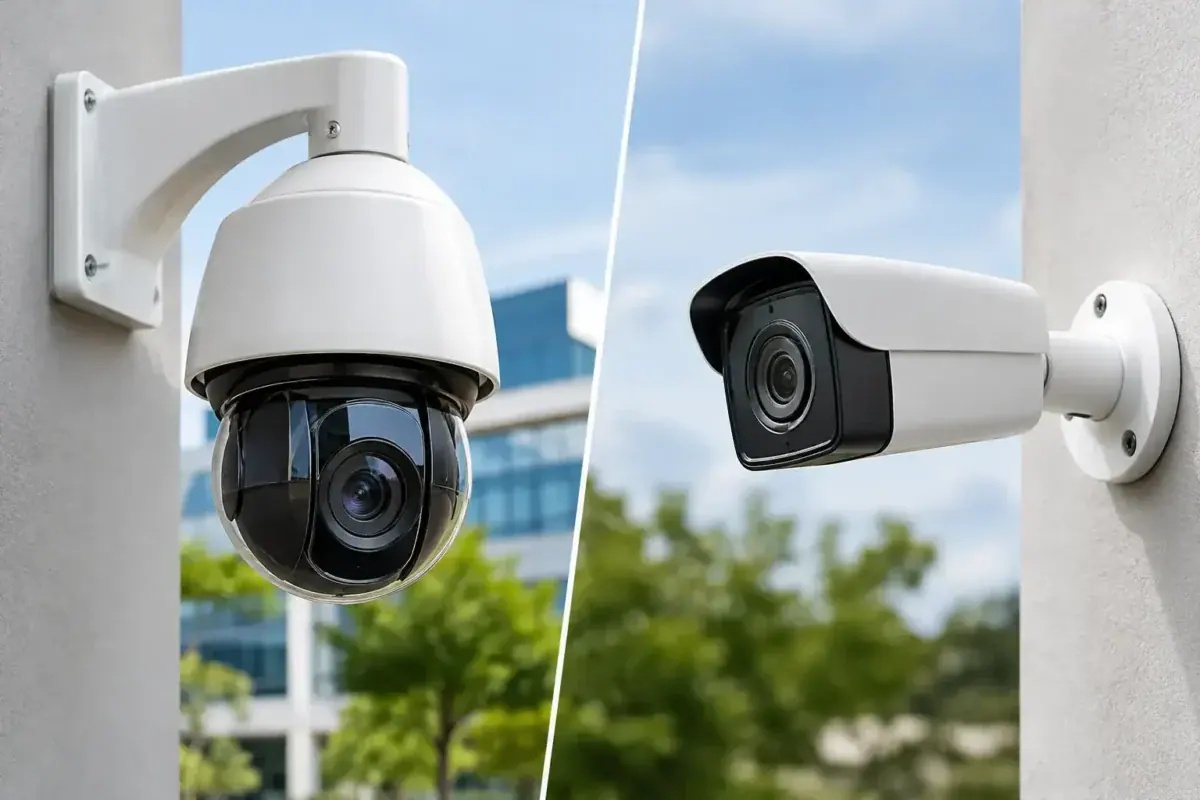
A camera overlooking a front entrance has one job: capture every person who comes through the door. A camera covering a large parking lot has a different job: identify activity across a wide, changing area. That distinction is what makes the decision between PTZ versus fixed security cameras more than a product preference. It affects what your system records, how your staff responds, and whether critical evidence is available when you need it.
For most properties, the best answer is not one camera type across the entire site. It is a system designed around entrances, cash-handling areas, perimeters, vehicle lanes, blind spots, and the daily activity that matters most to your operation.
PTZ Versus Fixed Security Cameras: The Core Difference
A fixed security camera points at a defined area and stays there. Bullet, dome, turret, panoramic, and many AI camera models fall into this category. Once designed and installed correctly, the camera maintains continuous coverage of its assigned scene, whether anyone is actively watching the system or not.
A PTZ camera can pan, tilt, and zoom. An operator can move it manually from a computer, mobile device, or joystick, while programmed presets and patrol patterns can direct the camera to specific areas automatically. Optical zoom lets a PTZ camera capture details farther away than a wide fixed lens can provide.
That mobility is valuable, but it creates a trade-off. When a PTZ is zoomed in on one subject or pointed toward one end of a lot, it is not recording the rest of the area from its original angle. A fixed camera never looks away. This is why a PTZ should rarely be the only camera protecting a broad or high-risk space.
When Fixed Cameras Are the Better Operational Choice
Fixed cameras are the foundation of most business-grade surveillance systems because they provide dependable, continuous documentation. They work especially well where the scene is predictable and evidence must be captured without relying on a live operator.
For a retail store, that may mean fixed cameras at each entrance, behind the counter, above point-of-sale stations, and facing aisles or display cases. A daycare may need fixed coverage at access doors, pickup areas, hallways, playground gates, and common rooms. At a residence, fixed cameras can protect doorways, driveways, side yards, and package delivery areas around the clock.
Their biggest advantage is accountability. Every camera has a specific assignment, and users know exactly what it will record. With the correct lens selection, mounting height, lighting, and retention settings, fixed cameras create a consistent video record that is easier to review after an incident.
Fixed cameras also tend to be more cost-efficient per covered view. That allows a property owner to use more dedicated camera positions rather than asking one device to handle several conflicting tasks. Modern AI-enabled fixed cameras can add people, vehicle, line-crossing, intrusion, and object-based alerts without changing where the camera is aimed.
Fixed camera limitations to plan for
A fixed camera cannot follow a person across a large yard, zoom in on a distant vehicle on demand, or inspect a developing situation at another part of the property. Its field of view is determined at installation. If the lot expands, shelving changes, or a new gate creates a blind spot, you may need to add or reposition a camera.
That is not a weakness when the system is designed properly. It simply means camera placement matters. A low-cost camera with a poor viewing angle will not become useful because it is mounted in a visible location.
Where PTZ Cameras Deliver Real Value
PTZ cameras are strong tools for active oversight of large, open, or variable environments. Parking lots, construction sites, industrial yards, school campuses, storage facilities, large retail exteriors, and multi-building properties can benefit from the ability to inspect activity beyond a fixed camera’s practical detail range.
In a parking facility, a PTZ can be sent to a preset near an entry lane, a payment kiosk, or a reported incident. At a construction site, a manager can inspect a gate, equipment staging area, material storage zone, or perimeter from one elevated camera position. For a property with a staffed security desk, a PTZ gives personnel a responsive camera they can use to assess alerts before dispatching someone onsite.
Optical zoom is the major differentiator. Digital zoom only enlarges pixels already captured. Optical zoom uses the camera lens to bring distant subjects closer while maintaining usable detail. For identifying activity across a large property, that distinction can be significant.
PTZ cameras can also use presets, tours, and auto-tracking features. Presets move the camera to saved positions quickly. Tours cycle through selected viewpoints. Auto-tracking can follow a detected person or vehicle under suitable conditions. These features are useful, but they should support a wider camera plan, not replace it.
PTZ limitations that are often overlooked
A PTZ camera has moving parts, requires careful configuration, and benefits from trained users. Its higher purchase and installation cost is justified when the site truly needs active coverage and long-range detail. It is not automatically the better choice for a small storefront entrance or a narrow hallway.
Auto-tracking also has limits. Heavy foot traffic, obstructions, poor lighting, rain, reflections, or several moving subjects can affect results. A camera may follow the wrong target or lose it entirely. For critical fixed views such as doors, registers, license plate lanes, and emergency exits, dedicated cameras remain the dependable choice.
The Best Design Usually Uses Both
A practical security plan often combines fixed cameras for continuous evidence with PTZ cameras for situational awareness. Think of fixed cameras as your permanent record and PTZ cameras as your responsive observation tool.
For example, a jewelry store may use fixed high-resolution cameras at entrances, showcases, registers, safes, and exterior doors. A PTZ mounted outside may provide staff or remote monitoring personnel with a wider view of the surrounding parking area after hours. The PTZ adds flexibility, while the fixed cameras ensure key transactions and access points are always documented.
A larger parking lot may use fixed cameras to continuously cover entrances, exits, pedestrian paths, pay stations, and vehicle lanes. A PTZ installed on a pole or building corner can then verify suspicious activity, follow an incident toward another zone, or inspect a remote area without sending personnel outside.
This layered approach also helps avoid a common mistake: installing one PTZ in the center of a property and assuming it covers everything. It may see everything at different times, but it cannot provide continuous detailed coverage of everything at once.
Questions to Ask Before Selecting Camera Types
Start with the incident you need the system to document. If a dispute occurs at a register, can the camera clearly show the transaction and the people involved? If someone enters through a side door, can you see their face and direction of travel? If a vehicle damages a gate, is there a dedicated view of the lane and plate area?
Then consider who will operate the system. A PTZ is more valuable when someone has the responsibility and time to use it, whether that is an onsite manager, security team, or remote monitoring provider. If video is mainly reviewed after an incident, fixed cameras should receive most of the budget.
Also account for the physical environment. Outdoor cameras need appropriate weather ratings, stable mounting, surge protection, adequate lighting, and a reliable network connection. Long cable runs, pole installations, wireless bridges, LTE or 5G connectivity, and recorder capacity should be designed as part of the system, not addressed after cameras are installed.
Finally, consider retention and evidence quality. A camera that produces excellent video but records for only a few days may not meet your needs. Higher resolutions, more cameras, AI analytics, and PTZ recording settings all affect storage requirements. The right recorder and hard drive configuration are part of the security decision.
Make the Camera Plan Match the Property
The right choice is based on the areas you must document continuously, the areas you need to inspect actively, and the level of response available at your property. Fixed cameras protect the views you cannot afford to miss. PTZ cameras extend your reach when conditions change or a situation needs closer attention.
Tech Security USA can help property owners and facility managers build a business-grade camera plan around the actual risks of the site, from camera placement and network design to installation coordination and same day support. A properly designed system gives every camera a job, so your team is not left guessing what happened after the fact.
Posted on GoogleTrustindex verifies that the original source of the review is Google. I visited the Tech Security USA orange to install security cameras for my home. I found it a very professional company, with high quality products that were made me impressed. I recommend it to anyone who are looking a professional security cameras company in onrange city of Orange County CA.Posted on GoogleTrustindex verifies that the original source of the review is Google. “Edit (this review is not “spam” which the owner claims it is and the story is absolutely real however it was about 2 years ago and if I wasn’t shy back then(9th grade) or I wish I had done/said something about my dad and I being taken advantage of as it was a scam (quoted at around $150 but after having to wait 3weeks instead of 3 days for the guy to charge us $300 for a cheap screen that no longer had a haptic button or working Touch ID along with many white pressure dots along the edges). Do not go here. If you look at most of their 5-star reviews, they are older than 7 years. I went here recently to fix my iPad Air (3rd gen). The problem was the screen's backlight wouldn't work, so it would just show a black image. The technician said he could get it done for around $150 and in 2-3 days he would call us (my dad and I). After a week of waiting, we decided to call but to no avail. We went to the place to check up on the work done, if any. We got there and the iPad was in the exact same spot as the day we left it there. The guy told us it would be ready in about 4 days, no later, and that he would call us. We never got the call, so we went back after about another 3 days of waiting for a call (2 weeks now). After waiting, we went back to the store for the iPad, and it appeared to us as if he had just gotten started by breaking the screen to replace it. After another week, we came back and he pulled it out from a drawer saying something along the lines of, "I was about to call you guys." The screen was working, but it was clearly a cheap screen that was ordered online, and the Touch ID didn’t work anymore. The button was replaced with a non-haptic one. There are many white dots along the edges of the screen that look as if someone pressed their thumb down too hard for too long. The guy said with all the "extra" work done to it, the new total would be $300. When my dad and I looked at each other, we knew that wasn’t right, but I watched my dad grab his wallet and pay. I wish I had said something because we were taken advantage of, and after a week, the iPad's screen isn’t functioning properly as it feels unresponsive.Posted on GoogleTrustindex verifies that the original source of the review is Google. Will somebody please tell the owner to stop responding? She’s only validating the bad reviews.Posted on GoogleTrustindex verifies that the original source of the review is Google. Little messy inside but brought an old Moto Z2 Play in to finalize my failed battery self install. Done when promised, phone looked as good as new and works fine. I'm happy.Posted on GoogleTrustindex verifies that the original source of the review is Google. Garbage screen quality do not come here the screen is more different then a regular apple screen they use low quality screens the whole screen shattered and has black lines throughout it after a tiny drop with a screen protector.Posted on GoogleTrustindex verifies that the original source of the review is Google. I needed a battery replacement for my Huawei p10, the engineer fixed it in a few days (he had to order the battery) and it was reasonable priced, very good, thank youPosted on GoogleTrustindex verifies that the original source of the review is Google. Great location and employees. Really came through when I needed help. Recommend this place to anyone.Posted on GoogleTrustindex verifies that the original source of the review is Google. My go to place for any laptop and iPhone repairs. Also very friendly and experienced guy James.
Resent Posts
PTZ Versus Fixed Security Cameras: Which Fits?
20 November 2026

7 Best Cameras for Jewelry Stores in 2026
18 November 2026
Table of Contents