
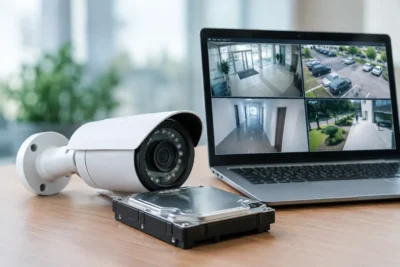
NVR vs DVR Systems: What Should You Install?
[yasr_overall_rating]

A recorder is the part of a surveillance system most people never think about until footage is missing, cameras are blurry, or an expansion becomes expensive. The NVR vs DVR systems decision determines what cameras you can use, how the system is wired, how much image detail you can retain, and how easily the property can grow over time.
For a small storefront replacing an older analog system, a DVR may be the practical answer. For a daycare, parking lot, construction site, or multi-camera commercial property where image detail and future expansion matter, an NVR system is usually the stronger long-term investment. The right choice depends on the building, the cable paths, the cameras required, and the level of evidence you need when an incident occurs.
NVR vs DVR Systems: The Core Difference
A DVR, or digital video recorder, works with analog security cameras. Those cameras send video to the recorder over coaxial cable, typically using BNC connectors. The DVR processes and records the video after it reaches the recorder.
An NVR, or network video recorder, works with IP cameras. Each camera processes video at the camera itself and sends digital video across a network cable to the NVR. In most professional installations, that means Cat5e or Cat6 cable with Power over Ethernet, also called PoE. One cable carries both power and data, which reduces the amount of infrastructure needed at each camera location.
That technical difference affects nearly every practical decision. DVR systems are often attractive when a property already has usable coaxial cable in place. NVR systems offer more flexibility, higher-resolution camera options, and a better foundation for modern features such as AI detection, people and vehicle filtering, audio, and license plate capture.
| Factor | DVR System | NVR System | | — | — | — | | Camera type | Analog or HD-over-coax cameras | IP network cameras | | Typical cable | Coaxial cable plus power | Cat5e/Cat6 PoE network cable | | Video processing | At the recorder | At the camera | | Expansion flexibility | More limited | Higher, with network planning | | Advanced analytics | Available on select models | Broad support across modern IP cameras | | Best fit | Cost-conscious upgrades using existing coax | New installs and higher-detail commercial coverage |
When a DVR System Makes Sense
DVR systems remain a valid business-grade option. The most common reason to choose one is existing infrastructure. If a building has coaxial cable already routed through finished walls, ceilings, or long conduit runs, reusing it can avoid significant labor and disruption.
A retail shop, small office, or home with a functioning analog camera layout may be able to upgrade to modern HD-over-coax cameras and a compatible DVR without pulling new network cable. This can improve image quality substantially while keeping installation costs under control. A properly selected DVR can still provide dependable remote viewing, motion recording, multiple camera channels, and adequate retention for many applications.
DVR is also worth considering when the property needs straightforward coverage rather than advanced analytics. For example, a small stockroom, front entrance, or low-risk interior area may not require AI-enabled alerts or ultra-high-resolution video. The key is to avoid treating a DVR as a universal low-cost substitute. It is best when its wiring model and camera limitations match the property.
There are trade-offs. Coaxial systems commonly require separate power connections for cameras unless a specialized power solution is used. Camera placement and expansion can become more labor-intensive, especially when new runs are needed. DVR systems also offer fewer choices in specialized cameras, including high-performance AI, panoramic, fisheye, and advanced license plate recognition models.
Why NVR Systems Lead Most New Installations
For new construction, remodels, and properties with demanding security needs, NVR systems are generally the preferred design. PoE cabling gives installers a clean, efficient way to connect each camera while supporting high-resolution digital video and advanced camera functions.
Image detail is a major factor. When a business needs to identify a face at an entrance, read activity at a cash wrap, follow a vehicle through a parking area, or document job-site access, camera resolution and lens selection matter. IP cameras used with NVRs are available in a broad range of resolutions and form factors, including turret, bullet, PTZ, panoramic, thermal, and license plate recognition cameras.
NVR systems are also better suited to intelligent alerts. Instead of receiving a notification every time rain, shadows, headlights, or tree branches trigger motion, AI-capable cameras can filter events for people, vehicles, and in some cases specific behaviors or zones. That is valuable for business owners who cannot spend their day reviewing false alarms.
Network-based design also supports more flexible deployment. A camera can connect to a PoE switch in another part of the building rather than requiring every cable to return directly to the recorder, provided the network is designed correctly. This is especially useful for larger facilities, separate buildings, parking areas, and multi-site operations.
An NVR is not automatically the right answer just because it is newer. Network cameras require proper bandwidth planning, managed switching when appropriate, secure passwords, firmware maintenance, and thoughtful separation from the general business network. Poor network design can create viewing delays, recording gaps, or cybersecurity concerns. A professionally designed system addresses those issues before cameras are mounted.
Camera Quality Matters More Than Recorder Labels
Comparing recorders alone can lead to the wrong purchase. A low-quality camera connected to an NVR will not create useful evidence simply because it is an IP camera. The final image depends on resolution, sensor size, lens angle, lighting, mounting height, frame rate, and recording settings.
A wide-angle camera may cover an entire lobby but fail to capture a usable face at the front door. A camera aimed across a dark parking lot may need stronger low-light performance, infrared illumination, or supplemental lighting. A license plate camera needs a controlled viewing angle and settings designed for moving vehicles. These are design issues, not just product specifications.
For businesses that handle cash, high-value merchandise, regulated operations, or frequent customer traffic, it is often better to use fewer properly positioned cameras than to install many cameras with poor coverage. Jewelry stores may prioritize entries, showcases, transaction areas, and exterior approaches. Daycares may require dependable coverage of entrances, hallways, pickup areas, and perimeter access while respecting privacy expectations. Construction sites may need durable exterior cameras, remote access, and cellular connectivity where fixed internet is unavailable.
Storage Planning Prevents Costly Gaps
Whether you choose an NVR or DVR, storage should be planned around retention requirements, not guessed at after installation. Recording time depends on camera count, resolution, activity level, frame rate, compression, and whether cameras record continuously or only on events.
A four-camera system recording motion events may retain footage for weeks on a modest hard drive. A 16-camera 4K system recording around the clock can consume storage much faster. If an incident is reported two weeks later and the footage has already been overwritten, the recorder did not meet its purpose.
Before selecting a recorder, establish how many days of footage you need. Many commercial properties target 30 days, but the right retention period can be longer or shorter based on operational needs, insurance requirements, incident reporting timelines, and available storage budget. Critical cameras can also be configured for continuous recording while lower-priority areas use intelligent event recording.
Use surveillance-rated hard drives rather than standard desktop drives. Surveillance recording creates continuous write activity, and the storage hardware must be selected for that workload. Redundant storage options may also be appropriate for larger operations where video availability is essential.
Installation Questions to Answer Before You Buy
The fastest way to choose between systems is to start with the property, not the recorder. Ask whether usable coaxial cable is already in place, whether new cable can be run without major construction, and whether the network can support IP cameras. Then identify the areas where evidence quality matters most.
You should also consider power availability, outdoor weather exposure, distance to remote cameras, internet reliability, and who will manage the system after installation. A recorder in a locked office with an uninterruptible power supply and a documented user setup will perform very differently from one installed in an accessible closet with no backup power or support plan.
For a simple coax upgrade, a DVR may deliver reliable results quickly. For a new business installation, a high-visibility exterior system, or a property that needs AI cameras and future expansion, an NVR system usually provides more value over the life of the installation. Tech Security USA can help match the recorder, camera mix, cabling, storage, and installation approach to the actual risks on your property.
Do not let a low upfront price decide a system that needs to protect your business for years. Choose the platform that gives you clear evidence where it counts, enough recording time to retrieve it, and a support path when your operations change.
Posted on GoogleTrustindex verifies that the original source of the review is Google. I visited the Tech Security USA orange to install security cameras for my home. I found it a very professional company, with high quality products that were made me impressed. I recommend it to anyone who are looking a professional security cameras company in onrange city of Orange County CA.Posted on GoogleTrustindex verifies that the original source of the review is Google. “Edit (this review is not “spam” which the owner claims it is and the story is absolutely real however it was about 2 years ago and if I wasn’t shy back then(9th grade) or I wish I had done/said something about my dad and I being taken advantage of as it was a scam (quoted at around $150 but after having to wait 3weeks instead of 3 days for the guy to charge us $300 for a cheap screen that no longer had a haptic button or working Touch ID along with many white pressure dots along the edges). Do not go here. If you look at most of their 5-star reviews, they are older than 7 years. I went here recently to fix my iPad Air (3rd gen). The problem was the screen's backlight wouldn't work, so it would just show a black image. The technician said he could get it done for around $150 and in 2-3 days he would call us (my dad and I). After a week of waiting, we decided to call but to no avail. We went to the place to check up on the work done, if any. We got there and the iPad was in the exact same spot as the day we left it there. The guy told us it would be ready in about 4 days, no later, and that he would call us. We never got the call, so we went back after about another 3 days of waiting for a call (2 weeks now). After waiting, we went back to the store for the iPad, and it appeared to us as if he had just gotten started by breaking the screen to replace it. After another week, we came back and he pulled it out from a drawer saying something along the lines of, "I was about to call you guys." The screen was working, but it was clearly a cheap screen that was ordered online, and the Touch ID didn’t work anymore. The button was replaced with a non-haptic one. There are many white dots along the edges of the screen that look as if someone pressed their thumb down too hard for too long. The guy said with all the "extra" work done to it, the new total would be $300. When my dad and I looked at each other, we knew that wasn’t right, but I watched my dad grab his wallet and pay. I wish I had said something because we were taken advantage of, and after a week, the iPad's screen isn’t functioning properly as it feels unresponsive.Posted on GoogleTrustindex verifies that the original source of the review is Google. Will somebody please tell the owner to stop responding? She’s only validating the bad reviews.Posted on GoogleTrustindex verifies that the original source of the review is Google. Little messy inside but brought an old Moto Z2 Play in to finalize my failed battery self install. Done when promised, phone looked as good as new and works fine. I'm happy.Posted on GoogleTrustindex verifies that the original source of the review is Google. Garbage screen quality do not come here the screen is more different then a regular apple screen they use low quality screens the whole screen shattered and has black lines throughout it after a tiny drop with a screen protector.Posted on GoogleTrustindex verifies that the original source of the review is Google. I needed a battery replacement for my Huawei p10, the engineer fixed it in a few days (he had to order the battery) and it was reasonable priced, very good, thank youPosted on GoogleTrustindex verifies that the original source of the review is Google. Great location and employees. Really came through when I needed help. Recommend this place to anyone.Posted on GoogleTrustindex verifies that the original source of the review is Google. My go to place for any laptop and iPhone repairs. Also very friendly and experienced guy James.
Resent Posts
How to Design Jobsite Surveillance That Works
21 October 2026
Surveillance System Maintenance Guide for Uptime
19 October 2026
Table of Contents