
AI Security Cameras for Business That Work
[yasr_overall_rating]
A camera that records everything but helps with nothing is a liability dressed up as security. For many businesses, that is the real problem – hours of footage, constant motion alerts, and no clear way to separate routine activity from actual risk. AI security cameras for business are built to solve that gap by turning video into something more useful: actionable information.
For owners, property managers, and facility teams, that matters because security is rarely just about recording an incident after the fact. It is about deterring theft, spotting operational issues sooner, verifying what happened, and giving staff a system they can actually use under pressure. The right AI-enabled setup can do that well. The wrong one can create a flood of notifications, network strain, and missed events. That is why the hardware, placement, recording design, and support model matter just as much as the AI label on the box.
What AI security cameras for business actually do
At the practical level, AI cameras use onboard processing or recorder-based analytics to identify people, vehicles, and sometimes specific behaviors or objects. Instead of flagging every moving shadow, tree branch, or headlight reflection, they can focus on targets that are more relevant to a business environment.
That sounds simple, but the benefit is significant. A smoke shop owner may want after-hours human detection near entry points, not alerts every time traffic passes the storefront. A daycare may need clear people-based activity review around pickup zones and perimeter gates. A construction site may need vehicle and person classification across open areas where ordinary motion detection would be almost useless.
Many business-grade systems can also support line crossing, intrusion zones, loitering alerts, people counting, and license plate capture when paired with the right camera type. These features are not interchangeable. The camera that works well at a back door is not necessarily the right one for a parking lot, warehouse aisle, or front counter. Good results come from matching the analytics to the scene.
Where AI cameras make the biggest difference
The biggest value usually shows up in three areas: fewer false alarms, faster incident review, and better coverage of high-risk activity.
False alarms waste time. If your manager gets twenty useless alerts before lunch, the system trains people to ignore it. AI reduces that noise when it is configured properly. That means alerts are more likely to be checked and acted on.
Incident review is another major advantage. When theft, vandalism, loitering, or an employee safety issue comes up, searching by person or vehicle can cut review time dramatically. Instead of scrubbing through hours of footage, staff can go directly to relevant events.
Then there is deterrence. Visible, well-installed AI surveillance has operational value even before an incident occurs. Customers, employees, and would-be offenders all notice the difference between a professional business-grade system and a low-cost setup with weak image quality and poor placement.
Choosing AI security cameras for business by property type
Different sites need different camera strategies. That is where many buyers make expensive mistakes.
A retail storefront usually benefits from a mix of wide coverage and close-up identification. You may need one camera for the entrance, another for the register area, and additional coverage for exterior approach paths. If theft is a concern, image detail and angle discipline matter more than adding a high camera count.
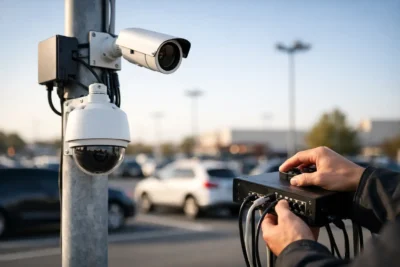
Parking facilities and exterior lots often need stronger analytics and longer-range performance. Vehicle detection, license plate recognition, and nighttime clarity become much more important here. Lighting conditions, headlight glare, and mounting height all affect performance.
Construction sites need durability, flexible networking, and thoughtful perimeter coverage. Temporary conditions change fast, and the camera plan has to account for shifting access points, equipment storage, and power or connectivity limits.
Daycares and other sensitive-use properties tend to prioritize reliable visibility, controlled access review, and consistent coverage around entrances, hallways, and pickup areas. In these settings, image quality and retention practices are often as important as smart alerts.
Jewelry stores and other high-value businesses usually need a layered approach. Overview cameras alone are not enough. You need close facial capture, strong front-of-house coverage, exterior deterrence, and recording infrastructure that can hold up when footage is needed for law enforcement or insurance review.
What to look for in a business-grade system
The camera itself is only part of the system. Reliable AI performance depends on the full design.
Image quality comes first. Analytics work better when the camera has enough resolution, proper lens selection, and adequate light handling. A low-quality camera with flashy feature claims will still struggle if faces are backlit or vehicles are captured at the wrong angle.
The recorder and storage plan matter too. Some systems process analytics at the edge, some at the recorder, and some use a mix. Retention time, frame rate, compression settings, and remote access all affect how useful the system will be after installation.
Networking is another common weak point. Businesses often add cameras without planning for bandwidth, switch capacity, remote access reliability, or backup connectivity. That is when users start blaming the cameras for problems that are really infrastructure issues.
Installation quality also changes the outcome. Mounting height, field of view, sun exposure, nighttime lighting, and cable routing all affect how well AI features perform. Cameras installed too high may provide broad coverage but poor identification. Cameras pointed into glare-heavy scenes may detect motion without delivering usable detail.
The trade-offs business owners should know
AI cameras are not magic, and a good security partner should say that plainly.
Analytics can reduce false alerts, but they still need tuning. Weather, lighting changes, reflective surfaces, and busy public-facing areas can all affect performance. A front entrance on a quiet office building behaves differently than a sidewalk-facing retail entrance in a dense urban area.
Higher-end analytics also come at a higher cost. In many cases, that cost is justified because it reduces labor, improves review speed, and strengthens evidence quality. But not every camera on a property needs every feature. A smart design puts advanced analytics where they create the most value and uses standard coverage where they do not.
Privacy and policy also matter. Businesses should be clear about what they are monitoring, how footage is retained, and who has access. The goal is better security and accountability, not overcomplication.
Why professional design matters more than feature lists
Many camera buyers start by comparing specs. That is understandable, but camera selection without site design usually leads to blind spots or overspending.
A proper business deployment starts with the property layout, risk points, operating hours, lighting conditions, and the kinds of incidents you actually need to catch. From there, the system can be built around the right mix of dome, bullet, PTZ, panoramic, or specialty cameras, plus the recorder, network hardware, and remote access setup needed to support them.
This is especially important for multi-site businesses and expanding operations. Standardizing equipment, retention settings, user permissions, and alert logic across locations makes management easier and support faster. It also helps avoid the patchwork problem where every site uses different hardware and no one can troubleshoot efficiently.
For West Coast businesses dealing with theft, liability concerns, and rising pressure to document incidents clearly, that operational consistency matters. A professionally designed system is easier to use, easier to maintain, and more dependable when something goes wrong.
When AI cameras are worth the investment
If your current system produces too many alerts, misses critical events, or makes footage review painfully slow, AI is usually worth serious consideration. The same is true if you manage a property with high foot traffic, after-hours exposure, or recurring theft and trespassing issues.
The strongest return usually comes when AI is paired with a real use case. That could mean after-hours intrusion alerts at a warehouse, customer dispute review in retail, vehicle tracking at a lot entrance, or perimeter monitoring on a job site. The clearer the use case, the better the system design.
For businesses that need the equipment selected correctly, installed correctly, and supported after the sale, working with a service-focused provider is the safer path. Tech Security USA approaches these systems as complete business infrastructure, not boxed products on a shelf. That difference shows up later in uptime, image quality, and support response.
The best camera system is not the one with the longest feature list. It is the one that fits your property, catches what matters, and keeps working when you need answers fast. If you are considering AI surveillance, start with the risks you need to solve and build from there.
Posted on GoogleTrustindex verifies that the original source of the review is Google. I visited the Tech Security USA orange to install security cameras for my home. I found it a very professional company, with high quality products that were made me impressed. I recommend it to anyone who are looking a professional security cameras company in onrange city of Orange County CA.Posted on GoogleTrustindex verifies that the original source of the review is Google. “Edit (this review is not “spam” which the owner claims it is and the story is absolutely real however it was about 2 years ago and if I wasn’t shy back then(9th grade) or I wish I had done/said something about my dad and I being taken advantage of as it was a scam (quoted at around $150 but after having to wait 3weeks instead of 3 days for the guy to charge us $300 for a cheap screen that no longer had a haptic button or working Touch ID along with many white pressure dots along the edges). Do not go here. If you look at most of their 5-star reviews, they are older than 7 years. I went here recently to fix my iPad Air (3rd gen). The problem was the screen's backlight wouldn't work, so it would just show a black image. The technician said he could get it done for around $150 and in 2-3 days he would call us (my dad and I). After a week of waiting, we decided to call but to no avail. We went to the place to check up on the work done, if any. We got there and the iPad was in the exact same spot as the day we left it there. The guy told us it would be ready in about 4 days, no later, and that he would call us. We never got the call, so we went back after about another 3 days of waiting for a call (2 weeks now). After waiting, we went back to the store for the iPad, and it appeared to us as if he had just gotten started by breaking the screen to replace it. After another week, we came back and he pulled it out from a drawer saying something along the lines of, "I was about to call you guys." The screen was working, but it was clearly a cheap screen that was ordered online, and the Touch ID didn’t work anymore. The button was replaced with a non-haptic one. There are many white dots along the edges of the screen that look as if someone pressed their thumb down too hard for too long. The guy said with all the "extra" work done to it, the new total would be $300. When my dad and I looked at each other, we knew that wasn’t right, but I watched my dad grab his wallet and pay. I wish I had said something because we were taken advantage of, and after a week, the iPad's screen isn’t functioning properly as it feels unresponsive.Posted on GoogleTrustindex verifies that the original source of the review is Google. Will somebody please tell the owner to stop responding? She’s only validating the bad reviews.Posted on GoogleTrustindex verifies that the original source of the review is Google. Little messy inside but brought an old Moto Z2 Play in to finalize my failed battery self install. Done when promised, phone looked as good as new and works fine. I'm happy.Posted on GoogleTrustindex verifies that the original source of the review is Google. Garbage screen quality do not come here the screen is more different then a regular apple screen they use low quality screens the whole screen shattered and has black lines throughout it after a tiny drop with a screen protector.Posted on GoogleTrustindex verifies that the original source of the review is Google. I needed a battery replacement for my Huawei p10, the engineer fixed it in a few days (he had to order the battery) and it was reasonable priced, very good, thank youPosted on GoogleTrustindex verifies that the original source of the review is Google. Great location and employees. Really came through when I needed help. Recommend this place to anyone.Posted on GoogleTrustindex verifies that the original source of the review is Google. My go to place for any laptop and iPhone repairs. Also very friendly and experienced guy James.
Resent Posts
Can Cameras Identify Shoplifters? What They Can Prove
28 August 2026
How to Monitor Remote Jobsites Without Blind Spots
26 August 2026
Table of Contents