
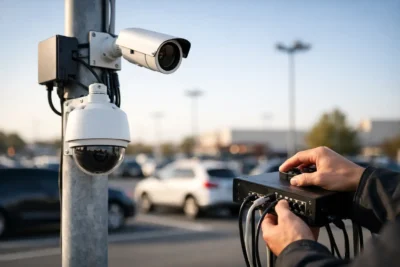
Business Grade Camera Brands That Work Harder
[yasr_overall_rating]
A camera that looks clear in a product demo can still fail the moment it matters: a face is backlit at your front door, a vehicle moves through a dark parking lot, or an employee needs footage from three weeks ago. That is why comparing business grade camera brands should start with operational performance, not a single specification or the lowest installed price.
For a retail store, daycare, construction site, or multi-property operation, the right brand is the one that supports your coverage plan, recording requirements, network capacity, and service expectations for years after installation. Hardware matters. So do firmware updates, warranty handling, replacement availability, and the ability to add cameras without rebuilding the entire system.
What Separates Business Grade Camera Brands
Business-grade surveillance equipment is designed for continuous operation, not occasional use. The difference shows up in image sensors, low-light processing, weather ratings, secure user management, storage options, and compatibility with professional video management systems.
A consumer camera may provide a quick alert and a short cloud clip. A business system needs to document a full incident. That can mean retaining high-resolution video for 30, 60, or 90 days, identifying a person at a doorway, following activity across a property, and exporting usable footage when law enforcement, insurance carriers, or management requests it.
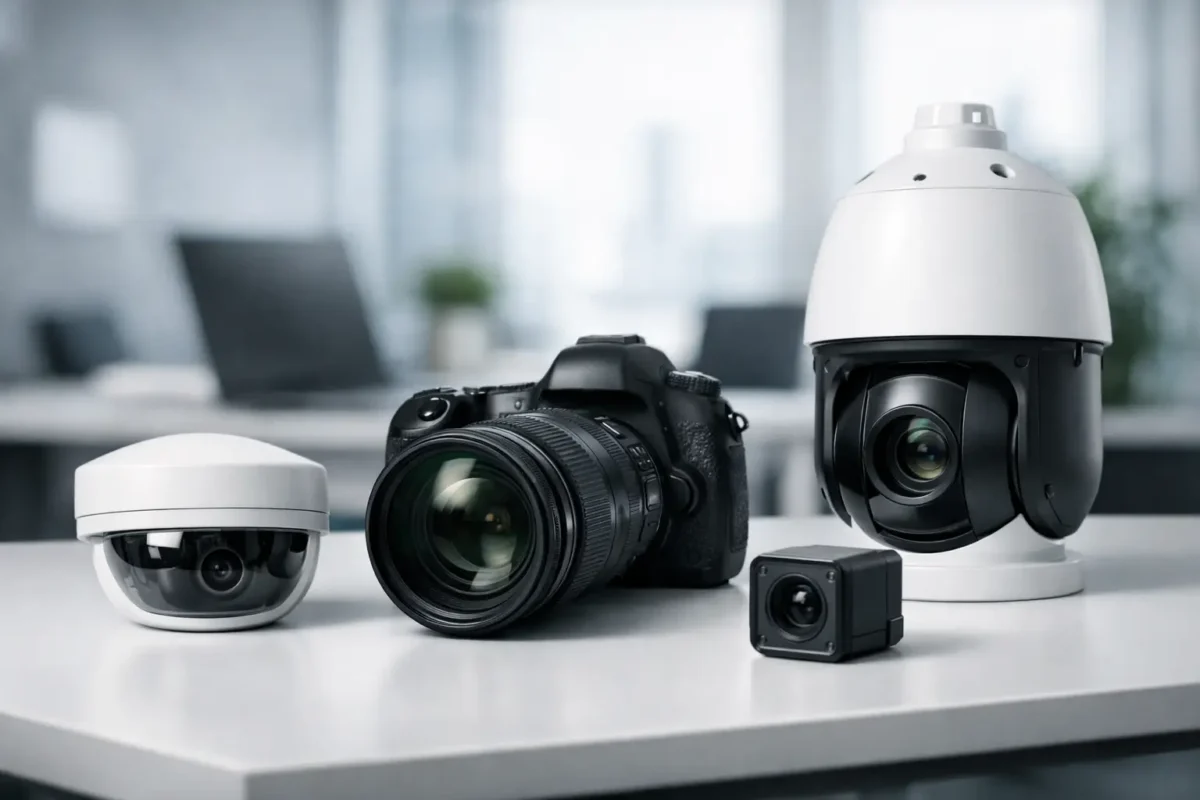
The strongest business grade camera brands also provide a broader product line. A single property may need vandal-resistant domes indoors, bullet cameras along a perimeter, a panoramic camera in a sales floor, and license plate recognition at an entrance. Buying into a professional ecosystem gives you more options without forcing staff to manage several disconnected apps and recorders.
The Brand Is Only Part of the System
Even premium hardware underperforms when it is placed incorrectly. A 4K camera mounted too high may capture a wide view but not enough facial detail. A license plate camera aimed like a standard driveway camera may miss plates at night. Wi-Fi may be acceptable in a small office, while a large parking facility needs wired PoE cameras, managed switching, surge protection, and properly sized recording storage.
This is why system design should come before brand loyalty. Start with what must be captured, when it must be available, and who needs access. Then select cameras and a platform that can meet those requirements without unnecessary complexity.
Leading Business Grade Camera Brands to Consider
There is no single best manufacturer for every property. Some brands are known for enterprise-scale video management, others for analytics, image quality, cloud administration, or value at larger camera counts. The right fit depends on the job.
Axis Communications
Axis is widely recognized in commercial and enterprise surveillance for dependable network cameras, long product life cycles, and broad integration support. It is often a strong choice for campuses, public-facing facilities, multi-site organizations, and projects where an open platform matters.
Axis equipment typically carries a higher upfront cost than value-oriented alternatives. That investment can make sense when a facility needs specialized cameras, detailed technical documentation, integration with access control or third-party software, and a system expected to remain in service for many years.
Hanwha Vision
Hanwha Vision offers a deep commercial camera lineup, including AI-enabled models, multi-sensor cameras, PTZ units, and cameras suited to challenging outdoor conditions. It is frequently considered for businesses that need strong low-light performance, intelligent search features, and a practical path from small installations to larger deployments.
For retail, parking lots, warehouses, and mixed-use properties, Hanwha can offer a good balance between advanced features and long-term system capability. As with any analytics platform, verify which features work at the edge, which require server resources, and how they perform in the actual lighting and traffic conditions of your site.
Avigilon
Avigilon is often selected by organizations that want analytics and video management to work closely together. Its product family is commonly used in larger commercial facilities, schools, logistics sites, and security operations where teams need to search video quickly and investigate events across many cameras.
The trade-off is that a full Avigilon deployment can be more specialized and may carry higher hardware, licensing, and support costs. It can be a strong operational fit when the value of faster investigation, centralized management, and advanced detection outweighs the added investment.
Bosch Security Systems
Bosch has a long presence in commercial security and is known for engineered camera solutions, strong image processing, and systems designed for demanding environments. It can be a good match for industrial facilities, critical infrastructure, large commercial buildings, and projects with specific compliance or integration requirements.
A Bosch-based system is usually not the lowest-cost route. It is best evaluated where quality, engineering standards, and project-specific performance are more important than simply maximizing the camera count.
Uniview and Other Value-Focused Commercial Platforms
Uniview and similar professional-grade manufacturers can be practical for small and midsize businesses that need reliable IP surveillance without enterprise-level costs across every camera. These platforms often include the essentials: NVR recording, remote access, AI-powered human and vehicle filtering, fixed cameras, PTZ cameras, and suitable outdoor options.
The key is to compare the exact model and recorder, not just the name on the box. Feature sets, warranty terms, update practices, availability, and integration options can vary significantly by product line. A well-designed value-focused system can outperform a poorly planned premium system.
How to Choose a Camera Brand for Your Property
Start with the security problem, not the catalog. A jewelry store may prioritize faces at entrances, transactions at display cases, and high-detail coverage of inventory areas. A daycare needs carefully placed interior and exterior coverage, controlled user access, and dependable footage retrieval. A construction site may need solar or cellular connectivity, temporary mounting, remote monitoring, and cameras that hold up to dust, weather, and changing layouts.
For parking lots, image quality after dark is usually more valuable than an inflated megapixel number. Look at lighting, vehicle speed, mounting distance, and whether you need general overview video or readable license plates. Those are separate camera tasks in many cases.
Ask each supplier or installer direct operational questions:
- How long will the system retain video at the selected resolution and frame rate?
- Can cameras identify people and vehicles without creating constant false alerts?
- Which cameras are suitable for low light, glare, rain, vandal risk, or extreme heat?
- Is the platform NDAA-compliant if your organization, contract, or funding source requires it?
- Who handles installation, training, warranty service, replacement hardware, and urgent support?
These answers reveal more than a brochure comparison. They show whether the proposed system was designed around your facility or assembled from whatever hardware was available.
Do Not Overbuy Features You Will Not Use
AI analytics, color night vision, active deterrence, panoramic coverage, and PTZ tracking can be valuable. They are not automatic upgrades for every camera location. A fixed camera with the right lens often provides more usable evidence at a doorway than an expensive PTZ pointed at a broad area.
Likewise, cloud-managed cameras may simplify administration for a multi-site operator, but recurring subscription costs should be planned over the full life of the system. Local NVR systems can provide more direct control and predictable storage costs, though they require appropriate network design and ongoing maintenance. Neither approach is automatically better.
The same discipline applies to resolution. Higher resolution creates more detail only when the lens, lighting, bandwidth, and storage are sized to support it. Otherwise, it can increase cost while leaving the actual identification problem unresolved.
Installation and Support Protect the Investment
A commercial surveillance system should be installed with service in mind. That includes labeling cables, protecting outdoor connections, documenting camera views, setting user permissions, confirming remote access, and training the people who will retrieve footage. It also means testing video at night, not just during a daytime walkthrough.
Tech Security USA helps property owners and business operators match professional camera brands to the way their locations actually operate. From camera selection and recorder sizing to installation coordination and same-day support, the goal is a system designed and installed correctly from the start.
Choose a camera brand that fits your risk, property layout, and support requirements, then insist on a design that proves every critical view before an incident puts it to the test.
Posted on GoogleTrustindex verifies that the original source of the review is Google. I visited the Tech Security USA orange to install security cameras for my home. I found it a very professional company, with high quality products that were made me impressed. I recommend it to anyone who are looking a professional security cameras company in onrange city of Orange County CA.Posted on GoogleTrustindex verifies that the original source of the review is Google. “Edit (this review is not “spam” which the owner claims it is and the story is absolutely real however it was about 2 years ago and if I wasn’t shy back then(9th grade) or I wish I had done/said something about my dad and I being taken advantage of as it was a scam (quoted at around $150 but after having to wait 3weeks instead of 3 days for the guy to charge us $300 for a cheap screen that no longer had a haptic button or working Touch ID along with many white pressure dots along the edges). Do not go here. If you look at most of their 5-star reviews, they are older than 7 years. I went here recently to fix my iPad Air (3rd gen). The problem was the screen's backlight wouldn't work, so it would just show a black image. The technician said he could get it done for around $150 and in 2-3 days he would call us (my dad and I). After a week of waiting, we decided to call but to no avail. We went to the place to check up on the work done, if any. We got there and the iPad was in the exact same spot as the day we left it there. The guy told us it would be ready in about 4 days, no later, and that he would call us. We never got the call, so we went back after about another 3 days of waiting for a call (2 weeks now). After waiting, we went back to the store for the iPad, and it appeared to us as if he had just gotten started by breaking the screen to replace it. After another week, we came back and he pulled it out from a drawer saying something along the lines of, "I was about to call you guys." The screen was working, but it was clearly a cheap screen that was ordered online, and the Touch ID didn’t work anymore. The button was replaced with a non-haptic one. There are many white dots along the edges of the screen that look as if someone pressed their thumb down too hard for too long. The guy said with all the "extra" work done to it, the new total would be $300. When my dad and I looked at each other, we knew that wasn’t right, but I watched my dad grab his wallet and pay. I wish I had said something because we were taken advantage of, and after a week, the iPad's screen isn’t functioning properly as it feels unresponsive.Posted on GoogleTrustindex verifies that the original source of the review is Google. Will somebody please tell the owner to stop responding? She’s only validating the bad reviews.Posted on GoogleTrustindex verifies that the original source of the review is Google. Little messy inside but brought an old Moto Z2 Play in to finalize my failed battery self install. Done when promised, phone looked as good as new and works fine. I'm happy.Posted on GoogleTrustindex verifies that the original source of the review is Google. Garbage screen quality do not come here the screen is more different then a regular apple screen they use low quality screens the whole screen shattered and has black lines throughout it after a tiny drop with a screen protector.Posted on GoogleTrustindex verifies that the original source of the review is Google. I needed a battery replacement for my Huawei p10, the engineer fixed it in a few days (he had to order the battery) and it was reasonable priced, very good, thank youPosted on GoogleTrustindex verifies that the original source of the review is Google. Great location and employees. Really came through when I needed help. Recommend this place to anyone.Posted on GoogleTrustindex verifies that the original source of the review is Google. My go to place for any laptop and iPhone repairs. Also very friendly and experienced guy James.
Resent Posts

Can Cameras Identify Shoplifters? What They Can Prove
28 August 2026
How to Monitor Remote Jobsites Without Blind Spots
26 August 2026
Table of Contents