
Construction Site Security Cameras That Work
[yasr_overall_rating]
A job site can lose thousands of dollars overnight from one blind spot. Missing tools, unauthorized entry, vandalism, and disputes over deliveries all add up fast, especially when multiple trades are moving in and out every day. That is why construction site security cameras are no longer a nice extra for large projects only. They have become a practical requirement for builders, general contractors, developers, and site managers who need clear visibility, better documentation, and fewer avoidable losses.
What construction site security cameras need to do
A construction site changes every week. Fencing moves, materials shift, temporary power comes and goes, and the highest-risk areas are not always in the same place for long. A camera system for this environment has to do more than record video. It needs to handle dust, weather, uneven lighting, and unreliable network conditions while still producing footage that is usable when an incident happens.
That is where many low-cost systems fall short. On paper, a cheap camera may offer high resolution, motion alerts, and mobile viewing. In the field, those features mean very little if the image washes out under floodlights, the camera goes offline during a network interruption, or the housing fails after exposure to rain and job-site debris. Construction security works best when the system is selected for the actual site conditions, not just the spec sheet.
The risks are not limited to after-hours theft
Most people think about nighttime break-ins first, and for good reason. Tools, copper, fuel, and stored materials remain common targets. But some of the most valuable uses for construction site security cameras happen during working hours.
Footage can verify when a delivery arrived, whether materials were dropped in the correct location, and how equipment was being used before damage was reported. It can help settle subcontractor disputes, document safety incidents, and provide a clearer timeline when an insurer or project owner needs answers. In some cases, cameras also improve site discipline because crews know access points, storage areas, and equipment yards are actively monitored.
This does not mean every site needs the same level of coverage. A small remodel with limited staging has very different requirements than a multi-phase commercial build with perimeter fencing, trailers, gates, and heavy equipment. The right approach depends on site size, power availability, line of sight, and what you are trying to prevent versus what you need to document.
Choosing the right camera types for a job site
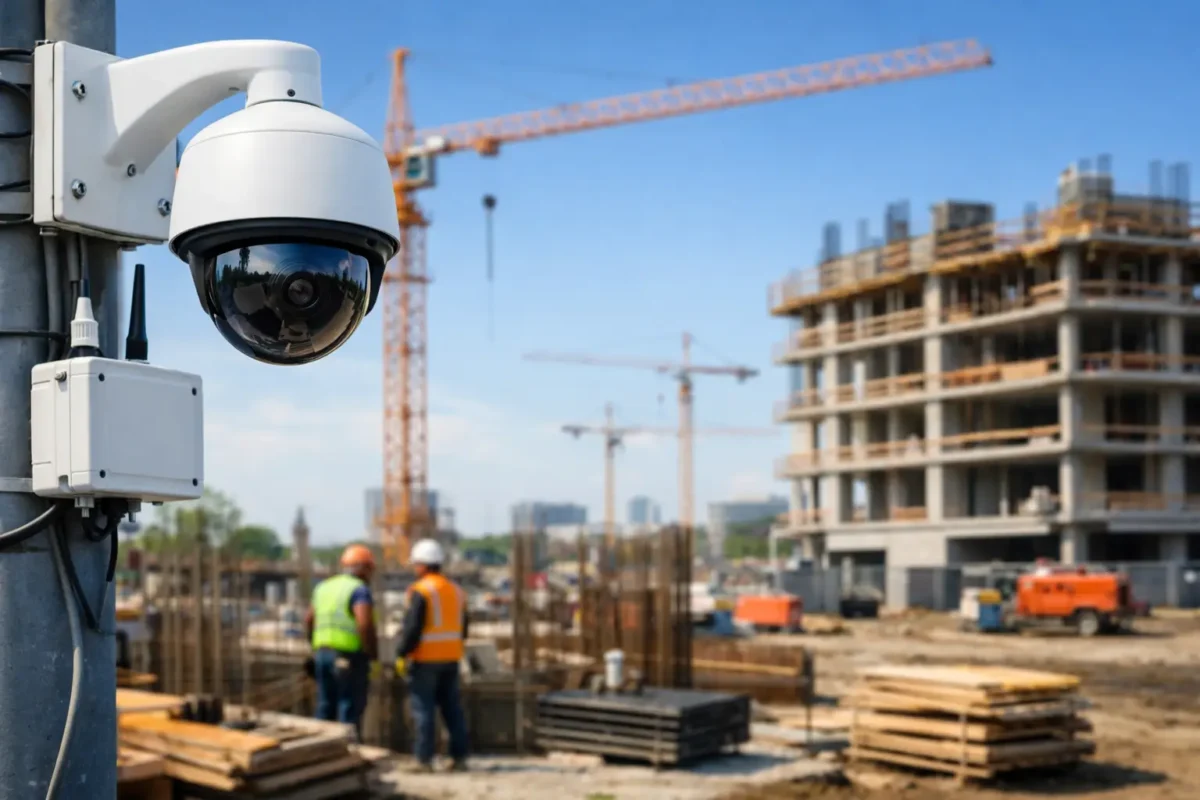
A strong construction camera system usually combines a few different camera roles instead of relying on one model everywhere. Fixed bullet cameras are often the starting point because they are visible, directional, and effective for perimeter lines, entry points, and material storage areas. Their presence alone can discourage opportunistic theft.
PTZ cameras add flexibility on larger sites where one camera may need to cover wide open space, zoom in on activity, or support live remote monitoring. They are useful, but they should not replace properly placed fixed cameras. If a PTZ is looking one direction, it is not watching another. That trade-off matters when you need consistent evidence.
Panoramic or fisheye cameras can work well around staging yards, trailer clusters, and open interior zones where broad situational awareness matters more than long-distance detail. For gates and vehicle access, license plate recognition can be worth considering, especially on sites with repeated after-hours traffic concerns or controlled access requirements.
The camera itself is only part of the system. Recording hardware, storage retention, remote access, power protection, and network stability all determine whether the footage is available when you need it. A camera that captures an incident but fails to store it correctly is not doing its job.
Placement matters more than most buyers expect
The biggest design mistake on construction sites is treating cameras like they should simply cover as much space as possible. Wide coverage sounds efficient, but security video is about useful detail. You need to identify faces at entry points, capture activity around tool containers, monitor parked equipment, and document vehicle movement where it matters.
Good placement starts with the site plan and the loss points. Gates, fencing gaps, storage containers, fuel tanks, parked machinery, temporary offices, and loading areas usually deserve priority. Elevated mounting helps expand the view, but too much height can reduce facial detail and make it harder to identify actions close to the camera.
Lighting also changes everything. A camera aimed directly toward work lights, sunrise glare, or reflective surfaces may perform poorly even if the resolution is high. Job sites often need a mix of day and night optimization, and that should be accounted for before installation, not after an incident.
Power and connectivity are often the real challenge
Construction projects are temporary environments. That means power may be incomplete, internet service may not be installed yet, and site layouts can change with little notice. This is why deployment planning matters just as much as the camera model.
Some sites can support a traditional wired system from a trailer or temporary office with local recording and structured cabling. Others need LTE or 5G connectivity because fixed internet is unavailable or unreliable during early project phases. In remote or fast-moving environments, wireless backhaul and cellular networking can keep a site covered without waiting on permanent infrastructure.
There is always a balance here. Wired connections usually offer the best long-term stability, but they are not always practical at the beginning of a project. Cellular deployment is faster, but bandwidth, signal strength, and data usage need to be planned correctly. If the system is expected to support remote live viewing, event alerts, and recorded playback, the network design needs to match that workload.
Why temporary installs still need professional design
A common misconception is that because a construction site is temporary, the security system can be improvised. In practice, temporary jobs often need more planning, not less. Equipment may need to be relocated as the build progresses. Camera angles may need adjustment after fencing shifts or new structures block views. Recording capacity may need to increase if incidents trigger more review requests.
A business-grade approach accounts for those changes from the start. It considers enclosure ratings, mounting methods, surge protection, storage retention, and serviceability. It also makes room for expansion, because many sites begin with perimeter coverage and later add interior shell monitoring, gate control, or trailer protection as the project matures.
For contractors and property owners, that translates into fewer surprises. The system is designed and installed correctly the first time, and when conditions change, support is available to adapt it rather than patch around problems.
What to expect from a business-grade system
The right system should give you clear remote visibility, consistent recording, and footage that can actually support a claim, investigation, or internal review. That means weather-rated hardware, strong night performance, stable networking, and enough storage to retain video for a reasonable period based on the site’s risk profile.
It should also be easy for the right people to use. A project manager may need mobile access to verify deliveries. An owner may want event notifications after hours. A superintendent may need to review footage tied to a safety issue. Access should be controlled, but the system should not be so complicated that nobody checks it until after a problem occurs.
This is where working with a provider that handles hardware selection, design guidance, installation coordination, and ongoing support makes a measurable difference. Tech Security USA serves many customers who are not looking for a box off a shelf. They need a site-ready system that fits the timeline, works under real field conditions, and comes with support when the project changes.
Getting the scope right from the start
If you are planning construction site security cameras, start by identifying the losses that would hurt most. For some sites, that is theft of stored tools and materials. For others, it is unauthorized entry, equipment damage, or lack of documentation around incidents and deliveries. Once those priorities are clear, the system can be built around them.
It is rarely necessary to overbuild every corner of the property. In fact, overspending on unnecessary coverage can leave less budget for the pieces that matter most, such as proper recording retention, better low-light performance, or more reliable connectivity. The goal is not maximum camera count. The goal is dependable coverage where operational risk is highest.
A well-planned camera system does more than watch a site. It gives contractors and owners a cleaner record of what happened, when it happened, and who was there. On a busy project, that kind of visibility pays for itself long before the final walkthrough.
Posted on GoogleTrustindex verifies that the original source of the review is Google. I visited the Tech Security USA orange to install security cameras for my home. I found it a very professional company, with high quality products that were made me impressed. I recommend it to anyone who are looking a professional security cameras company in onrange city of Orange County CA.Posted on GoogleTrustindex verifies that the original source of the review is Google. “Edit (this review is not “spam” which the owner claims it is and the story is absolutely real however it was about 2 years ago and if I wasn’t shy back then(9th grade) or I wish I had done/said something about my dad and I being taken advantage of as it was a scam (quoted at around $150 but after having to wait 3weeks instead of 3 days for the guy to charge us $300 for a cheap screen that no longer had a haptic button or working Touch ID along with many white pressure dots along the edges). Do not go here. If you look at most of their 5-star reviews, they are older than 7 years. I went here recently to fix my iPad Air (3rd gen). The problem was the screen's backlight wouldn't work, so it would just show a black image. The technician said he could get it done for around $150 and in 2-3 days he would call us (my dad and I). After a week of waiting, we decided to call but to no avail. We went to the place to check up on the work done, if any. We got there and the iPad was in the exact same spot as the day we left it there. The guy told us it would be ready in about 4 days, no later, and that he would call us. We never got the call, so we went back after about another 3 days of waiting for a call (2 weeks now). After waiting, we went back to the store for the iPad, and it appeared to us as if he had just gotten started by breaking the screen to replace it. After another week, we came back and he pulled it out from a drawer saying something along the lines of, "I was about to call you guys." The screen was working, but it was clearly a cheap screen that was ordered online, and the Touch ID didn’t work anymore. The button was replaced with a non-haptic one. There are many white dots along the edges of the screen that look as if someone pressed their thumb down too hard for too long. The guy said with all the "extra" work done to it, the new total would be $300. When my dad and I looked at each other, we knew that wasn’t right, but I watched my dad grab his wallet and pay. I wish I had said something because we were taken advantage of, and after a week, the iPad's screen isn’t functioning properly as it feels unresponsive.Posted on GoogleTrustindex verifies that the original source of the review is Google. Will somebody please tell the owner to stop responding? She’s only validating the bad reviews.Posted on GoogleTrustindex verifies that the original source of the review is Google. Little messy inside but brought an old Moto Z2 Play in to finalize my failed battery self install. Done when promised, phone looked as good as new and works fine. I'm happy.Posted on GoogleTrustindex verifies that the original source of the review is Google. Garbage screen quality do not come here the screen is more different then a regular apple screen they use low quality screens the whole screen shattered and has black lines throughout it after a tiny drop with a screen protector.Posted on GoogleTrustindex verifies that the original source of the review is Google. I needed a battery replacement for my Huawei p10, the engineer fixed it in a few days (he had to order the battery) and it was reasonable priced, very good, thank youPosted on GoogleTrustindex verifies that the original source of the review is Google. Great location and employees. Really came through when I needed help. Recommend this place to anyone.Posted on GoogleTrustindex verifies that the original source of the review is Google. My go to place for any laptop and iPhone repairs. Also very friendly and experienced guy James.
Resent Posts
How to Design Jobsite Surveillance That Works
21 October 2026
Surveillance System Maintenance Guide for Uptime
19 October 2026
Table of Contents