
Jewelry Store Surveillance System Basics
[yasr_overall_rating]
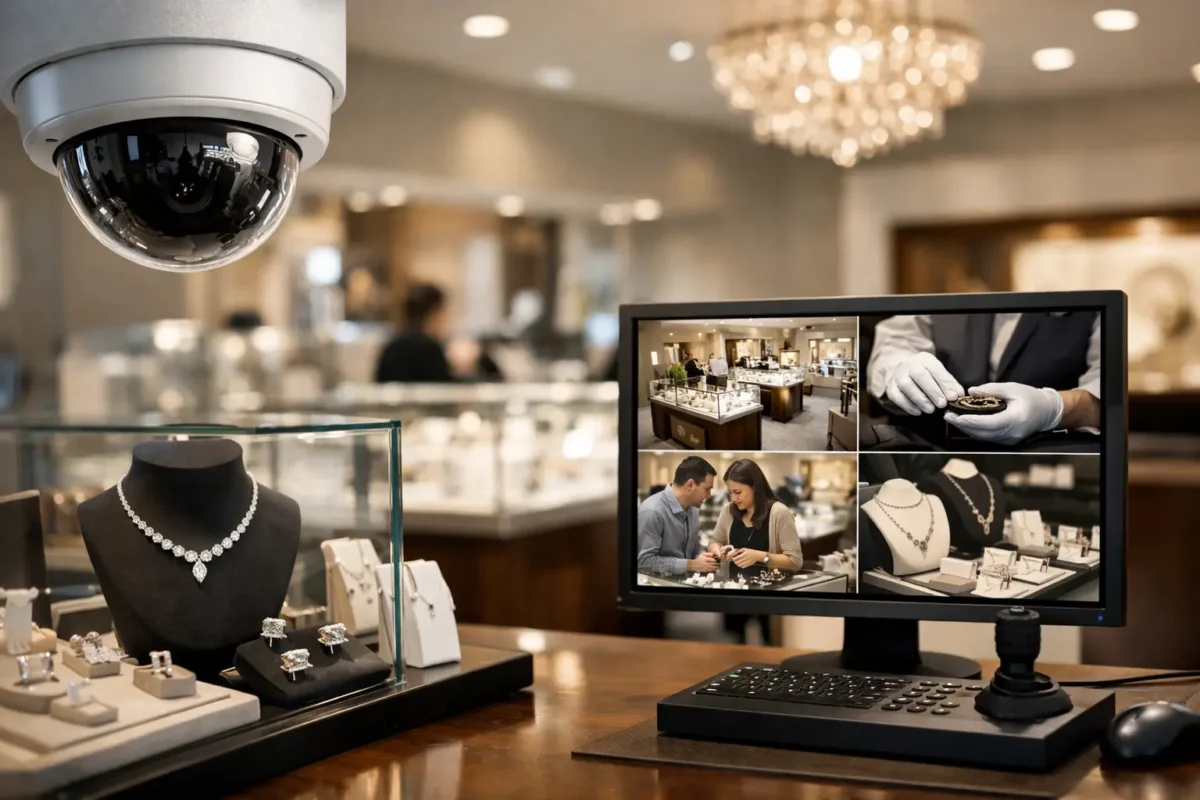
A stolen ring can disappear in seconds. What matters after that is whether your jewelry store surveillance system caught a clear face, a clean handoff, the exact display case interaction, and the path to the exit – not just a blurry clip that proves something happened.
Jewelry stores operate in a high-risk environment where shrink, grab-and-run incidents, internal theft, after-hours break-ins, and fraudulent claims all carry real financial impact. That is why camera placement, image quality, storage design, and alarm integration have to be planned around how the store actually works. A generic camera package is rarely enough for a showroom with high-value inventory, glass counters, customer traffic, and strict insurance expectations.
What a jewelry store surveillance system needs to do
At a minimum, the system has to deter theft, document incidents, and hold up when footage is reviewed by management, law enforcement, or insurance adjusters. Those are not the same thing. A visible camera may discourage a casual thief, but if it is mounted too high or aimed too wide, it may not capture the facial detail or hand movement you need when something goes missing.
For most jewelry retailers, the real objective is layered visibility. You need broad coverage of the showroom, tight identification at entry and exit points, close views of display cases and transaction areas, and dependable recording in back-of-house spaces where inventory is handled. When those layers work together, you are not relying on a single camera angle to explain an event.
This is also where system design becomes operational, not just technical. A store that handles frequent repairs, custom orders, and safe access has different surveillance needs than a boutique focused on walk-in luxury sales. The right design depends on traffic flow, display layout, staffing patterns, and where your highest-value exposure actually sits.
Camera coverage for a jewelry store surveillance system
The most common mistake in a jewelry store is treating all camera views as equal. They are not. Overview cameras help you understand movement and timing, but identification cameras are what turn footage into evidence. Both matter, but they serve different jobs.
Front entrance and storefront
Your entrance should capture faces coming in and going out, even with changing light from glass doors and street-facing windows. That usually means using cameras with strong wide dynamic range and positioning that avoids backlighting issues. If the person is wearing a hat or hood, camera angle matters just as much as resolution.
Exterior storefront coverage also helps document loitering, suspicious vehicles, smash-and-grab attempts, and after-hours activity. In some cases, additional parking lot or sidewalk views are worth adding, especially if there is limited line of sight from neighboring businesses.
Showroom floor and display cases
Wide views of the showroom establish movement, traffic patterns, and who was near a case at a given time. But that should be backed up with tighter shots of high-value display zones. You want to see interactions at the case level, including hand placement, drawer access, and whether items were returned correctly.
This is where lens selection and mounting height become critical. Too wide, and you lose detail. Too tight, and you create blind spots between cases. In many jewelry stores, a mix of dome cameras for discrete interior coverage and more targeted cameras over select counters gives better results than one camera style used everywhere.
Point of sale and consultation areas
Transaction footage matters for chargebacks, disputes, switch fraud, and internal accountability. A point-of-sale camera should capture both the customer and the employee interaction without glare from overhead lighting or reflections off glass cases. Audio may or may not be appropriate depending on local laws and your operational needs, so that decision should be made carefully.
Consultation desks, repair intake counters, and appraisal stations are also worth covering. These are places where valuable items are handled directly, paperwork changes hands, and misunderstandings can become claims later.
Back office, stockroom, and safe access
Some of the most important footage in a jewelry environment is away from the showroom. Inventory receiving, tagging, transfers, and safe access should be documented clearly. If multiple employees handle merchandise in shared work areas, surveillance helps establish chain of custody and supports internal controls without relying only on memory.
These spaces do not need flashy hardware. They need dependable cameras, clean angles, and storage that keeps footage available when a discrepancy is found days or weeks later.
Image quality, storage, and retention
Higher resolution sounds like the obvious answer, but resolution alone does not solve surveillance problems. Frame rate, lighting, compression, lens choice, and recorder settings all affect what you can actually pull from footage. A poorly configured 4K camera can still fail at the moment you need it.
For jewelry stores, retaining usable footage for a reasonable period is often more important than chasing maximum specs on paper. If a missing item is not noticed until inventory review, short retention windows create a serious gap. The right recorder and storage plan should reflect how long it may take to identify loss, review incidents, and preserve evidence.
Remote access also matters, especially for owners managing multiple locations or spending time off-site. Being able to review a live event, check an alarm-triggered clip, or confirm an opening procedure from a mobile device adds operational value beyond pure security. But remote access has to be set up correctly, with secure networking and reliable bandwidth, or it becomes another weak point.
Why alarms and access control matter
A jewelry store surveillance system works better when it is part of a broader protection plan. Cameras record. Alarms create immediate response. Access control limits who can enter sensitive areas and gives you a usable event log.
If someone enters the stockroom after hours, you want more than video. You want a recorded access event, an alarm condition if that access is unauthorized, and footage tied to the exact time of entry. That kind of integration shortens investigations and reduces guesswork.
It also helps during opening and closing procedures. Many incidents happen during transition periods when doors are being unlocked, safes are being accessed, and staff are moving inventory. Those routines are predictable, which makes them vulnerable if security is not designed around them.
Installation quality is where performance is decided
A jewelry store can buy business-grade cameras and still end up with a weak system if installation is rushed or generic. Reflections from glass, hot spots from lighting, poor cable routing, weak recorder placement, and missed blind spots all show up later, usually after a loss event.
Professional design and installation reduce those risks. The installer should account for display case reflections, customer sightlines, mounting surfaces, after-hours lighting conditions, network reliability, and how staff actually move inventory through the store. This is especially important in remodels or tenant improvements where security has to work around finished interiors.
For stores in Seattle, California, and similar high-traffic retail markets, local experience helps. Regulations, building conditions, and crime patterns vary by area. A partner that handles design, installation, and support can usually spot issues before they become expensive mistakes.
Choosing the right system for your store
The right approach depends on store size, inventory profile, staffing, and risk tolerance. A small boutique may need a tightly designed system with fewer cameras but stronger coverage at the cases, entrance, and back office. A larger showroom may need broader zoning, more storage capacity, and multiple layers of identification coverage.
Budget matters, but cutting the wrong corners usually costs more later. The best value is not the cheapest equipment. It is a system designed and installed correctly, with support available when footage needs to be retrieved, settings need adjustment, or hardware needs service. That is where many retailers see the difference between commodity cameras and a business-grade deployment.
At Tech Security USA, that means helping jewelry retailers match the system to the actual risk on the floor, not overselling features they will never use. Good security should support daily operations, satisfy management, and stand ready when the store needs proof.
If you are planning a new build, upgrading an aging recorder, or fixing blind spots in an existing setup, start with the parts of the store where loss would hurt the most. The right system is the one that shows you exactly what happened, clearly enough to act on it.
Posted on GoogleTrustindex verifies that the original source of the review is Google. I visited the Tech Security USA orange to install security cameras for my home. I found it a very professional company, with high quality products that were made me impressed. I recommend it to anyone who are looking a professional security cameras company in onrange city of Orange County CA.Posted on GoogleTrustindex verifies that the original source of the review is Google. “Edit (this review is not “spam” which the owner claims it is and the story is absolutely real however it was about 2 years ago and if I wasn’t shy back then(9th grade) or I wish I had done/said something about my dad and I being taken advantage of as it was a scam (quoted at around $150 but after having to wait 3weeks instead of 3 days for the guy to charge us $300 for a cheap screen that no longer had a haptic button or working Touch ID along with many white pressure dots along the edges). Do not go here. If you look at most of their 5-star reviews, they are older than 7 years. I went here recently to fix my iPad Air (3rd gen). The problem was the screen's backlight wouldn't work, so it would just show a black image. The technician said he could get it done for around $150 and in 2-3 days he would call us (my dad and I). After a week of waiting, we decided to call but to no avail. We went to the place to check up on the work done, if any. We got there and the iPad was in the exact same spot as the day we left it there. The guy told us it would be ready in about 4 days, no later, and that he would call us. We never got the call, so we went back after about another 3 days of waiting for a call (2 weeks now). After waiting, we went back to the store for the iPad, and it appeared to us as if he had just gotten started by breaking the screen to replace it. After another week, we came back and he pulled it out from a drawer saying something along the lines of, "I was about to call you guys." The screen was working, but it was clearly a cheap screen that was ordered online, and the Touch ID didn’t work anymore. The button was replaced with a non-haptic one. There are many white dots along the edges of the screen that look as if someone pressed their thumb down too hard for too long. The guy said with all the "extra" work done to it, the new total would be $300. When my dad and I looked at each other, we knew that wasn’t right, but I watched my dad grab his wallet and pay. I wish I had said something because we were taken advantage of, and after a week, the iPad's screen isn’t functioning properly as it feels unresponsive.Posted on GoogleTrustindex verifies that the original source of the review is Google. Will somebody please tell the owner to stop responding? She’s only validating the bad reviews.Posted on GoogleTrustindex verifies that the original source of the review is Google. Little messy inside but brought an old Moto Z2 Play in to finalize my failed battery self install. Done when promised, phone looked as good as new and works fine. I'm happy.Posted on GoogleTrustindex verifies that the original source of the review is Google. Garbage screen quality do not come here the screen is more different then a regular apple screen they use low quality screens the whole screen shattered and has black lines throughout it after a tiny drop with a screen protector.Posted on GoogleTrustindex verifies that the original source of the review is Google. I needed a battery replacement for my Huawei p10, the engineer fixed it in a few days (he had to order the battery) and it was reasonable priced, very good, thank youPosted on GoogleTrustindex verifies that the original source of the review is Google. Great location and employees. Really came through when I needed help. Recommend this place to anyone.Posted on GoogleTrustindex verifies that the original source of the review is Google. My go to place for any laptop and iPhone repairs. Also very friendly and experienced guy James.
Resent Posts
How to Secure Parking Lot Cameras Properly
30 August 2026
Can Cameras Identify Shoplifters? What They Can Prove
28 August 2026
Table of Contents