
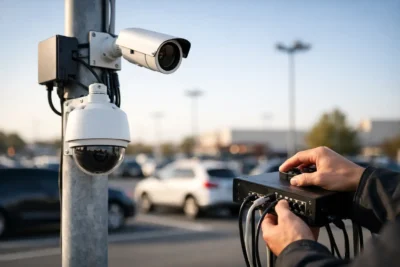
PTZ Camera for Parking Lot Surveillance
[yasr_overall_rating]
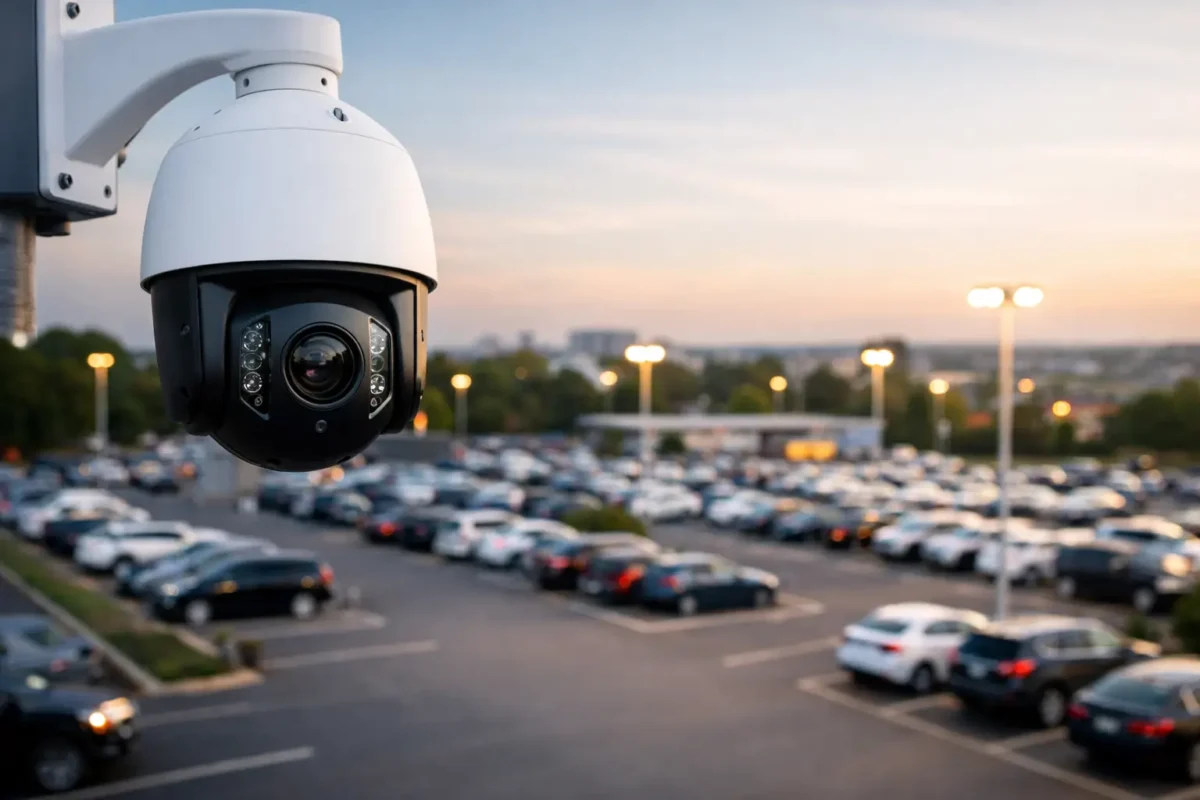
A parking lot can look covered on paper and still leave you blind where it matters most. The problem usually shows up after an incident – a vehicle enters too fast, someone cuts across a low-lit section, or a plate is unreadable because the camera was too wide, too high, or pointed at the wrong angle. A PTZ camera for parking lot surveillance can solve those gaps, but only when it is selected and installed as part of a complete system rather than treated like a single-camera fix.
When a PTZ camera for parking lot surveillance makes sense
PTZ stands for pan, tilt, and zoom. In a parking lot, that matters because activity is spread out, lighting changes by the hour, and incidents rarely happen exactly where a fixed camera is aimed. A PTZ gives operators the ability to follow movement, zoom into a vehicle aisle, check a gate, or verify what is happening near entrances and pay stations.
That flexibility is the main reason property owners choose PTZ cameras for larger exterior areas. A single unit can cover broad views during normal operation, then tighten in on a suspicious vehicle or person when needed. For apartment complexes, retail centers, office lots, industrial yards, and mixed-use properties, that range can add real value.
But there is a trade-off. A PTZ can only look in one direction at a time. If it is tracking activity on the far side of the lot, it is not actively watching the entrance lane. That is why the best parking lot designs do not rely on PTZ alone. They pair it with fixed cameras that continuously record choke points, entrances, exits, pedestrian paths, and any location where you need uninterrupted evidence.
What a PTZ camera does better than a fixed camera
A fixed camera is consistent. It records the same area 24 hours a day, which is exactly what you want for gates, building doors, and designated lanes. A PTZ camera is different. It is built for active coverage, long-range identification, and operator control.
In a parking lot, that means a PTZ can do three jobs especially well. First, it can provide a wide-area overview from a pole or building corner. Second, it can zoom in for closer visual detail when something needs review in real time. Third, it can move between preset positions on a schedule, which helps monitor several zones without needing a separate camera for every angle.
This is where system design matters. If your goal is simply to know whether someone entered the lot, a PTZ may be more camera than you need. If your goal is to monitor multiple rows, loading areas, and perimeter fencing while keeping the option to zoom in during an event, a PTZ starts to make operational sense.
The features that matter most in parking lot surveillance
Zoom range gets the most attention, but it should not be the only buying factor. Optical zoom is what counts, not digital zoom. Optical zoom preserves usable image detail as the lens moves closer. For larger lots, longer zoom can be valuable, especially when the camera is mounted at a distance from the target area.
Low-light performance is just as important. Parking lots create difficult lighting conditions because headlights, shadows, pole lights, and dark corners all exist in the same scene. A PTZ with strong night performance, wide dynamic range, and properly tuned IR or supplemental illumination will produce much better evidence than a camera that only looks good in daytime specifications.
Autotracking can also be useful, but it is not a substitute for system planning. In some environments, autotracking helps security teams follow a person or vehicle across open space. In others, it can be distracted by normal traffic, trees moving in the wind, or overlapping motion patterns. It depends on the site layout, traffic volume, and how often someone is actually watching the system live.
Weather rating, vandal resistance, and motor reliability also matter more outdoors than many buyers expect. Parking lot cameras deal with rain, dust, heat, cold, and constant movement cycles. Business-grade hardware is worth it here because the cost of a failed exterior camera is never just the replacement cost – it is also the coverage gap, labor time, and lost confidence in the system.
Placement is where most parking lot camera plans go right or wrong
A good PTZ camera in the wrong location will still disappoint. Height, angle, and viewing purpose all affect performance. Mounted too high, the camera may give a nice overview but poor facial detail and weak license plate capture. Mounted too low, it may be easier to tamper with and lose the broader field of view that makes PTZ useful.
For most parking lots, the PTZ should be positioned to oversee movement patterns rather than simply centered in the middle of the lot. That often means looking across travel lanes, toward entrances, over payment areas, or along the perimeter where loitering and unauthorized access are more likely to happen. The goal is not just visibility. The goal is usable coverage of the places where incidents start, escalate, or need to be documented.
It is also important to think about what the PTZ should never be responsible for. Entry and exit lanes, for example, usually need dedicated cameras if plate or driver detail is important. The PTZ can support those areas, but it should not be the only source of evidence.
PTZ presets, tours, and active monitoring
One of the most practical features in a parking lot setup is the use of presets. A PTZ can be programmed to return to specific positions such as the main entrance, the far row, a dumpster enclosure, or a loading zone. That gives the system a repeatable patrol pattern when no one is manually controlling it.
For some sites, preset tours are enough. For others, especially locations with on-site staff or remote monitoring, live control adds real value. A property manager can check a suspicious vehicle, a store operator can verify after-hours movement, or security personnel can follow activity in real time. The difference comes down to whether the camera is being used purely for recording or as part of day-to-day operations.
Storage, networking, and system integration
A PTZ camera is only as reliable as the infrastructure behind it. Exterior deployments need stable network connectivity, proper power planning, and enough recording capacity to retain useful footage. High-resolution PTZ cameras can consume significant bandwidth, especially if they are configured for quality over compression.
That does not mean every site needs an oversized system. It means the recorder, network switches, cabling, and remote access setup should match the camera count and use case. If you want smooth remote viewing, live PTZ control, and reliable playback after an incident, those details need to be designed correctly from the beginning.
Integration is another point buyers often underestimate. Many parking lots benefit from combining PTZ coverage with fixed overview cameras, license plate recognition cameras, alarms, intercoms, or smart video analytics. If package theft, break-ins, trespassing, or after-hours dumping are part of the risk profile, the PTZ should support that broader strategy instead of operating as a standalone add-on.
Choosing the right PTZ camera for parking lot surveillance
The right camera depends on lot size, lighting conditions, mounting options, and what level of detail you actually need. A small private lot behind a retail business has different requirements than a multi-building apartment property or a commercial yard with overnight vehicle storage.
This is where generic online buying advice usually falls short. Spec sheets do not tell you whether a camera angle will be blocked by light poles, whether the zoom is excessive for the distance involved, or whether your current recorder can support the upgrade. A properly designed system accounts for coverage goals, evidence needs, environmental conditions, and serviceability over time.
For many customers, the better path is not buying the most expensive PTZ. It is choosing a business-grade model that fits the site and pairing it with the right fixed cameras. That approach typically delivers better evidence, fewer blind spots, and less operator frustration.
If you are evaluating a PTZ camera for parking lot surveillance, treat it as part of the full security layout, not the whole layout by itself. The best results come from matching camera type to task, installing it at the right height and angle, and making sure support is available when adjustments are needed. At Tech Security USA, that is usually the difference between a camera system that looks impressive on install day and one that keeps doing its job months and years later.
A parking lot is one of the first places tenants, customers, and staff judge whether a property is being managed well. When the camera system is designed and installed correctly, it does more than record incidents – it helps prevent them.
Posted on GoogleTrustindex verifies that the original source of the review is Google. I visited the Tech Security USA orange to install security cameras for my home. I found it a very professional company, with high quality products that were made me impressed. I recommend it to anyone who are looking a professional security cameras company in onrange city of Orange County CA.Posted on GoogleTrustindex verifies that the original source of the review is Google. “Edit (this review is not “spam” which the owner claims it is and the story is absolutely real however it was about 2 years ago and if I wasn’t shy back then(9th grade) or I wish I had done/said something about my dad and I being taken advantage of as it was a scam (quoted at around $150 but after having to wait 3weeks instead of 3 days for the guy to charge us $300 for a cheap screen that no longer had a haptic button or working Touch ID along with many white pressure dots along the edges). Do not go here. If you look at most of their 5-star reviews, they are older than 7 years. I went here recently to fix my iPad Air (3rd gen). The problem was the screen's backlight wouldn't work, so it would just show a black image. The technician said he could get it done for around $150 and in 2-3 days he would call us (my dad and I). After a week of waiting, we decided to call but to no avail. We went to the place to check up on the work done, if any. We got there and the iPad was in the exact same spot as the day we left it there. The guy told us it would be ready in about 4 days, no later, and that he would call us. We never got the call, so we went back after about another 3 days of waiting for a call (2 weeks now). After waiting, we went back to the store for the iPad, and it appeared to us as if he had just gotten started by breaking the screen to replace it. After another week, we came back and he pulled it out from a drawer saying something along the lines of, "I was about to call you guys." The screen was working, but it was clearly a cheap screen that was ordered online, and the Touch ID didn’t work anymore. The button was replaced with a non-haptic one. There are many white dots along the edges of the screen that look as if someone pressed their thumb down too hard for too long. The guy said with all the "extra" work done to it, the new total would be $300. When my dad and I looked at each other, we knew that wasn’t right, but I watched my dad grab his wallet and pay. I wish I had said something because we were taken advantage of, and after a week, the iPad's screen isn’t functioning properly as it feels unresponsive.Posted on GoogleTrustindex verifies that the original source of the review is Google. Will somebody please tell the owner to stop responding? She’s only validating the bad reviews.Posted on GoogleTrustindex verifies that the original source of the review is Google. Little messy inside but brought an old Moto Z2 Play in to finalize my failed battery self install. Done when promised, phone looked as good as new and works fine. I'm happy.Posted on GoogleTrustindex verifies that the original source of the review is Google. Garbage screen quality do not come here the screen is more different then a regular apple screen they use low quality screens the whole screen shattered and has black lines throughout it after a tiny drop with a screen protector.Posted on GoogleTrustindex verifies that the original source of the review is Google. I needed a battery replacement for my Huawei p10, the engineer fixed it in a few days (he had to order the battery) and it was reasonable priced, very good, thank youPosted on GoogleTrustindex verifies that the original source of the review is Google. Great location and employees. Really came through when I needed help. Recommend this place to anyone.Posted on GoogleTrustindex verifies that the original source of the review is Google. My go to place for any laptop and iPhone repairs. Also very friendly and experienced guy James.
Resent Posts

Can Cameras Identify Shoplifters? What They Can Prove
28 August 2026
How to Monitor Remote Jobsites Without Blind Spots
26 August 2026
Table of Contents