
Best Cameras for Storefront Security for Retailers
[yasr_overall_rating]

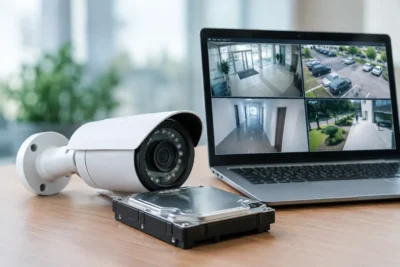
A storefront camera system has one job when an incident happens: provide a clear, usable answer. Can you identify the person at the door? See what was taken? Confirm which vehicle left the lot? The best cameras for storefront security are not simply the ones with the highest resolution. They are business-grade cameras placed to capture the right activity, supported by dependable recording and installed correctly for the property.
For retailers, the weak point is usually not a lack of cameras. It is a gap in coverage. A camera may show that someone entered, but not their face. Another may cover the register, but glare from the front windows washes out the image. A low-cost outdoor unit may work in daylight and fail when a vehicle pulls up after dark. Storefront security should be designed around those practical conditions before equipment is selected.
What the Best Cameras for Storefront Security Must Do
A well-designed storefront system documents three critical areas: entry and exit activity, transactions and high-value merchandise, and activity outside the building. Each area needs a different camera view and sometimes a different camera type.
At the front entrance, the priority is facial identification. A camera should be positioned at a useful angle and height, not mounted so high that it only captures hats and the tops of heads. Strong wide dynamic range is essential for glass doors and windows, where bright sunlight behind a subject can turn a face into a shadow. A 4MP or 8MP camera is often appropriate, but placement matters more than resolution alone.
Over registers, counters, display cases, and cash offices, use a focused view that shows hands, merchandise, and transaction activity. For jewelry stores, smoke shops, and other high-theft retail environments, these cameras should capture close detail without leaving blind spots around showcases or employee-only areas. A fixed turret, dome, or varifocal camera can work well depending on ceiling height and the exact coverage area.
Outside, a weather-rated bullet or turret camera is usually the workhorse. It should cover the front walk, doors, sidewalk approach, loading area, and side access points. Good infrared performance helps after closing, while built-in white light can add visible deterrence where appropriate. For parking lots and rear alleys, the camera needs enough light and the correct lens to identify activity at the actual distance that matters. A wide lens may cover the whole lot but produce weak detail at the far edge.
Choose Camera Types by Coverage, Not Marketing
Fixed cameras should handle most storefront coverage. They are reliable, cost-effective, and always pointed at the area that matters. Dome and turret cameras are common indoors because they offer a clean appearance and can be difficult for customers or staff to redirect. Bullet cameras are often better for exterior walls, where their visible presence can discourage loitering, vandalism, and attempted break-ins.
Varifocal cameras deserve serious consideration at entrances, registers, and long exterior approaches. Their adjustable lens lets the installer fine-tune the field of view during setup. This is useful when a camera must cover a doorway from across a parking area or capture a narrow passage between buildings. The trade-off is higher equipment cost and a more deliberate setup process, but the improvement in usable detail can be substantial.
Panorama and fisheye cameras can reduce the number of units needed in open sales floors, lobbies, or areas with multiple aisles. They provide broad situational coverage, but they are not the right choice for every identification task. A single panoramic view may show where an event occurred, while a dedicated fixed camera provides the face or product detail needed for an investigation.
PTZ cameras are useful for larger properties, active parking lots, and locations with security personnel monitoring live video. They can pan, tilt, and zoom to follow activity, but they should not replace fixed cameras. When a PTZ is looking one direction, it is not documenting another. Use it as an added operational tool, not as the only camera protecting a critical door or register.
License plate recognition cameras are a specialized addition for properties with recurring vehicle issues, employee parking, delivery access, or high-value inventory. A standard security camera may show a vehicle entering the lot, but a properly designed LPR camera is configured to capture plates at a specific lane, speed, angle, and lighting condition. It needs careful placement. Installing one as a general overview camera will not produce dependable plate reads.
Image Quality That Holds Up After Dark
Retail owners often ask whether 4K is necessary. It depends on the scene. Higher resolution can help with digital zoom, product detail, and wider coverage, especially in a large retail floor. It also increases storage and network demands. In a small shop with a properly positioned camera at the entrance and register, a quality 4MP camera may provide better results than an 8MP camera placed too far away.
Low-light performance is just as important as daytime resolution. Exterior cameras should be selected for real nighttime conditions, including parking lot lighting, streetlights, reflective storefront glass, and vehicle headlights. Infrared illumination can show activity in darkness, but reflective surfaces and close objects can create glare. In some settings, a camera with active white light or enhanced color night vision produces a more useful image and creates a stronger visual deterrent.
Wide dynamic range should be treated as a requirement at glass entrances and any location facing bright windows. Without it, the camera can struggle to expose both the bright outdoor background and the person walking inside. For storefronts in Seattle and California, where daylight angles, wet pavement, and window reflections can change the image quickly, this feature makes a practical difference.
AI Alerts Should Reduce Noise, Not Create More Work
Modern AI cameras can distinguish people, vehicles, and other objects from general motion. That means fewer alerts from rain, moving shadows, tree branches, or headlights. For a business owner, this is valuable only when the alert rules match how the store operates.
A useful setup may send a notification when a person approaches the rear door after hours, when a vehicle enters a restricted area, or when someone lingers near the front entrance after closing. During business hours, those same rules may need to be relaxed so normal customers do not generate constant notifications. The goal is actionable awareness, not an alert feed that gets ignored by the second day.
AI can also support perimeter protection by triggering lights, audible warnings, or intrusion alarms when an after-hours boundary is crossed. The right response depends on the location and local operating conditions. A busy urban storefront may need discreet alerts, while an isolated warehouse or construction site may benefit from a more visible response.
Recording, Retention, and Network Design Matter
A camera is only as useful as the footage you can retrieve. For most storefronts, a network video recorder with a properly sized hard drive provides the control and reliability needed for continuous recording. Cloud storage can be useful for remote access or backup, but relying only on cloud recording may create recurring costs and depend heavily on internet bandwidth.
Retention should be based on the business, not a guess. A small store may need 30 days of footage. A location with frequent inventory disputes, delayed theft discovery, or multiple stakeholders may need 60 to 90 days. Higher resolution, more cameras, and continuous recording all require more storage, so the recorder should be sized before the system is installed.
The network also needs attention. Business-grade cameras require stable power and data connections, usually through Power over Ethernet. A professional installation should account for cable routes, weather exposure, surge protection, switch capacity, recorder location, secure passwords, and remote user permissions. These details are often what separate a system that works for years from one that becomes unreliable after the first network issue or power event.
Storefront Layouts That Need Extra Planning
Daycares need camera coverage that supports safety and accountability while respecting privacy requirements. Entrances, exterior play areas, reception spaces, and access-controlled doors are common priorities. Camera placement should be planned carefully around sensitive areas and the organization’s policies.
Jewelry stores and smoke shops generally need tighter detail at display cases, registers, safes, entrances, and exterior approaches. Visible cameras can deter opportunistic theft, but discreet coverage may also be needed to document activity without drawing attention to every camera angle.
Retail centers and multi-tenant properties need a broader view. Parking areas, dumpsters, service corridors, shared entrances, and delivery routes can become blind spots when responsibility is split between tenants and property management. A coordinated camera plan helps establish who owns each coverage area and how footage will be accessed when an incident occurs.
Build a System Around the Risks You Actually Have
The right storefront system is rarely a boxed kit with the same camera over every door and aisle. It is a coverage plan built around your highest-risk areas, opening hours, lighting, inventory value, and the time you need footage retained. Tech Security USA can help property owners and operators select business-grade equipment, coordinate installation, and keep the system supported after it is live.
Before buying, stand outside your storefront after dark and look at it from the perspective of a customer, employee, delivery driver, or intruder. The places where you cannot clearly see activity are usually the places your camera design needs to solve first.
Posted on GoogleTrustindex verifies that the original source of the review is Google. I visited the Tech Security USA orange to install security cameras for my home. I found it a very professional company, with high quality products that were made me impressed. I recommend it to anyone who are looking a professional security cameras company in onrange city of Orange County CA.Posted on GoogleTrustindex verifies that the original source of the review is Google. “Edit (this review is not “spam” which the owner claims it is and the story is absolutely real however it was about 2 years ago and if I wasn’t shy back then(9th grade) or I wish I had done/said something about my dad and I being taken advantage of as it was a scam (quoted at around $150 but after having to wait 3weeks instead of 3 days for the guy to charge us $300 for a cheap screen that no longer had a haptic button or working Touch ID along with many white pressure dots along the edges). Do not go here. If you look at most of their 5-star reviews, they are older than 7 years. I went here recently to fix my iPad Air (3rd gen). The problem was the screen's backlight wouldn't work, so it would just show a black image. The technician said he could get it done for around $150 and in 2-3 days he would call us (my dad and I). After a week of waiting, we decided to call but to no avail. We went to the place to check up on the work done, if any. We got there and the iPad was in the exact same spot as the day we left it there. The guy told us it would be ready in about 4 days, no later, and that he would call us. We never got the call, so we went back after about another 3 days of waiting for a call (2 weeks now). After waiting, we went back to the store for the iPad, and it appeared to us as if he had just gotten started by breaking the screen to replace it. After another week, we came back and he pulled it out from a drawer saying something along the lines of, "I was about to call you guys." The screen was working, but it was clearly a cheap screen that was ordered online, and the Touch ID didn’t work anymore. The button was replaced with a non-haptic one. There are many white dots along the edges of the screen that look as if someone pressed their thumb down too hard for too long. The guy said with all the "extra" work done to it, the new total would be $300. When my dad and I looked at each other, we knew that wasn’t right, but I watched my dad grab his wallet and pay. I wish I had said something because we were taken advantage of, and after a week, the iPad's screen isn’t functioning properly as it feels unresponsive.Posted on GoogleTrustindex verifies that the original source of the review is Google. Will somebody please tell the owner to stop responding? She’s only validating the bad reviews.Posted on GoogleTrustindex verifies that the original source of the review is Google. Little messy inside but brought an old Moto Z2 Play in to finalize my failed battery self install. Done when promised, phone looked as good as new and works fine. I'm happy.Posted on GoogleTrustindex verifies that the original source of the review is Google. Garbage screen quality do not come here the screen is more different then a regular apple screen they use low quality screens the whole screen shattered and has black lines throughout it after a tiny drop with a screen protector.Posted on GoogleTrustindex verifies that the original source of the review is Google. I needed a battery replacement for my Huawei p10, the engineer fixed it in a few days (he had to order the battery) and it was reasonable priced, very good, thank youPosted on GoogleTrustindex verifies that the original source of the review is Google. Great location and employees. Really came through when I needed help. Recommend this place to anyone.Posted on GoogleTrustindex verifies that the original source of the review is Google. My go to place for any laptop and iPhone repairs. Also very friendly and experienced guy James.
Resent Posts
How to Design Jobsite Surveillance That Works
21 October 2026
Surveillance System Maintenance Guide for Uptime
19 October 2026
Table of Contents