
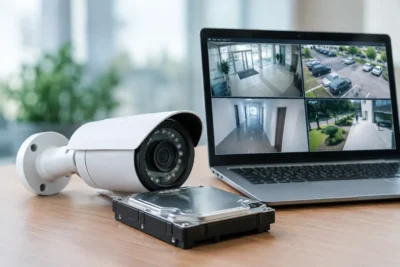
Dome vs Bullet Cameras for Your Property
[yasr_overall_rating]

A camera that records a clear image but is mounted in the wrong place can still leave a property exposed. The choice between dome vs bullet cameras affects deterrence, viewing angles, maintenance, installation methods, and how well a system holds up over time. For a home, storefront, daycare, parking lot, or job site, the right answer depends less on appearance and more on what needs to be documented.
Both camera styles are available with business-grade features such as AI detection, infrared night vision, remote viewing, and high-resolution recording. The housing shape does not determine image quality on its own. It does, however, determine how the camera handles real-world conditions, from tampering and rain to a customer noticing the camera before they reach your front door.
Dome vs Bullet Cameras: The Practical Difference
A dome camera places the lens inside a compact, rounded protective cover. It is commonly mounted on a ceiling or soffit and is often used indoors, under covered entrances, and in areas where a lower-profile installation is preferred. Many dome models allow the lens to be aimed after the housing is mounted, making them useful for watching registers, hallways, entry doors, and common areas.
A bullet camera has a longer, cylindrical body that projects outward from the mounting point. Its direction is easy to identify from a distance, which can make it a stronger visual deterrent. Bullet cameras are frequently installed on exterior walls, poles, fences, and building corners where they need to cover driveways, gates, loading areas, or long property lines.
Neither design is automatically better. A dome installed at a front entrance may provide cleaner coverage and better protection against casual tampering. A bullet camera aimed down a long alley may deliver a more practical view with easier adjustment. System design should start with the scene, not the camera shape.
When a Dome Camera Is the Better Fit
Dome cameras are a strong choice where appearance, vandal resistance, and broad-area monitoring matter. Their compact profile can be less intrusive inside a retail store, office, home, or childcare facility. At the same time, the camera’s orientation is less obvious to someone looking up at it, which can make it harder to tell exactly what the device is covering.
The enclosed housing also provides an advantage in accessible locations. A properly rated vandal-resistant dome is more difficult to grab, redirect, or damage than a protruding camera. This makes domes useful near entrances, elevators, interior corridors, storefront ceilings, and areas where customers or visitors can reach the equipment.
There are trade-offs. The clear dome cover must stay clean for the camera to produce a sharp image, especially at night. Dust, water spots, scratches, or condensation can create infrared glare and reduce image detail. An installer also needs adequate space to open the housing, aim the lens, and service the camera later. Tight soffits and uneven mounting surfaces can complicate that work.
For indoor coverage, dome cameras are often the practical default. They can provide a clean installation while monitoring activity without making every room feel like a high-security zone.
When a Bullet Camera Is the Better Fit
Bullet cameras are built for visibility and directional coverage. Their longer body makes it clear that a location is being watched, which is valuable at parking lot entrances, delivery doors, construction perimeters, back alleys, and side gates. For businesses managing theft, dumping, trespassing, or after-hours access, that visible deterrent can be part of the security plan.
They are also easier to aim during installation. An installer can quickly adjust a bullet camera toward a driveway, vehicle entrance, gate latch, or specific path of travel. That flexibility is helpful when a site has long distances to cover or when the camera needs to look beyond a roof edge or wall face.
On exposed exterior walls, bullet cameras can be easier to maintain because the lens is accessible without opening a dome housing. But their exposed shape also gives insects and spider webs more places to gather. A web across the lens or infrared LEDs can trigger motion alerts and reduce nighttime visibility. Placement, periodic cleaning, and proper mounting height all matter.
A bullet camera should not be installed simply because it looks more powerful. If it is mounted too low, points directly at bright headlights, or covers a wide area with a lens that is too narrow, it may not capture useful evidence. Directional cameras need a defined purpose.
Camera Performance Matters More Than the Housing
The dome or bullet decision is only one part of a working surveillance system. A camera must be selected around the distance to the subject, the lighting conditions, the required detail, and the recording plan. A wide-angle camera can show that someone entered a parking lot, but it may not provide a usable face image or readable vehicle plate at the far end of the lot.
For exterior cameras in Seattle and California, weather ratings matter. Look for equipment designed for rain, dust, heat, and temperature changes, along with mounting hardware that keeps cables protected. For reachable cameras, impact resistance is equally relevant. A business-grade camera should be paired with a secure junction box or mount rather than leaving connections exposed on the exterior wall.
Night performance deserves the same level of attention. Infrared lighting is useful for general monitoring, but a camera aimed at a dark driveway, bright storefront sign, or vehicle headlights may need stronger low-light performance and wide dynamic range. In some cases, adding controlled white light or relocating the camera produces better results than upgrading resolution alone.
AI detection can reduce nuisance alerts by distinguishing people and vehicles from general motion. That feature is especially useful for busy storefronts, parking facilities, and homes with trees, pets, or passing traffic. Still, analytics need to be configured around the actual scene. An alert zone that includes a public sidewalk may create more notifications than a property owner can realistically manage.
Dome vs Bullet Cameras by Use Case
For a retail counter, hallway, office, daycare classroom entrance, or residential interior, dome cameras are usually the cleanest fit. They are compact, difficult to redirect, and well suited to ceiling-mounted coverage. A dome at a front door or covered porch can also work well when the area is protected from direct weather exposure.
For a parking lot, loading zone, exterior gate, long driveway, or job-site perimeter, bullet cameras often make more sense. They offer visible deterrence and are easy to direct toward a specific approach route. A properly selected bullet camera can monitor a gate opening, vehicle path, or distant access point without being limited by a ceiling-based mounting position.
Jewelry stores and smoke shops commonly need both styles. Domes can cover sales floors, transaction areas, and interior doors, while bullets monitor parking areas, rear exits, and delivery access. The same mixed approach works for multi-site businesses: standardize the system where possible, then use the camera housing that best fits each location.
License plate capture is a separate use case. A standard dome or bullet camera aimed generally at a driveway may record vehicles, but it is not automatically a license plate recognition solution. Plate capture requires the correct camera, lens, angle, lighting, and installation height for vehicle speed and travel direction. This is where a site assessment prevents expensive gaps.
Avoid the Most Common Installation Mistake
The most common mistake is treating cameras as standalone products instead of parts of a complete security system. Camera placement affects cable paths, network capacity, recorder storage, remote access, power requirements, and future expansion. A camera mounted quickly today may be difficult to service tomorrow if there is no junction box, no protected cable route, or no practical way to adjust it.
A strong design also avoids blind spots between cameras. Exterior corners, rear doors, cash handling areas, gates, and vehicle approaches should be mapped before equipment is ordered. For higher-risk properties, camera views should overlap enough to establish where a person came from and where they went.
The right system is designed and installed correctly for the property, then supported after installation. Tech Security USA can help match dome, bullet, AI, PTZ, and specialized cameras to the risks that matter at your site, with professional installation coordination and same day support when it is needed.
Before choosing a housing style, stand where an incident is most likely to happen and ask one practical question: what evidence would you need from this exact location? That answer will usually point to the right camera, lens, mounting position, and recording setup.
Posted on GoogleTrustindex verifies that the original source of the review is Google. I visited the Tech Security USA orange to install security cameras for my home. I found it a very professional company, with high quality products that were made me impressed. I recommend it to anyone who are looking a professional security cameras company in onrange city of Orange County CA.Posted on GoogleTrustindex verifies that the original source of the review is Google. “Edit (this review is not “spam” which the owner claims it is and the story is absolutely real however it was about 2 years ago and if I wasn’t shy back then(9th grade) or I wish I had done/said something about my dad and I being taken advantage of as it was a scam (quoted at around $150 but after having to wait 3weeks instead of 3 days for the guy to charge us $300 for a cheap screen that no longer had a haptic button or working Touch ID along with many white pressure dots along the edges). Do not go here. If you look at most of their 5-star reviews, they are older than 7 years. I went here recently to fix my iPad Air (3rd gen). The problem was the screen's backlight wouldn't work, so it would just show a black image. The technician said he could get it done for around $150 and in 2-3 days he would call us (my dad and I). After a week of waiting, we decided to call but to no avail. We went to the place to check up on the work done, if any. We got there and the iPad was in the exact same spot as the day we left it there. The guy told us it would be ready in about 4 days, no later, and that he would call us. We never got the call, so we went back after about another 3 days of waiting for a call (2 weeks now). After waiting, we went back to the store for the iPad, and it appeared to us as if he had just gotten started by breaking the screen to replace it. After another week, we came back and he pulled it out from a drawer saying something along the lines of, "I was about to call you guys." The screen was working, but it was clearly a cheap screen that was ordered online, and the Touch ID didn’t work anymore. The button was replaced with a non-haptic one. There are many white dots along the edges of the screen that look as if someone pressed their thumb down too hard for too long. The guy said with all the "extra" work done to it, the new total would be $300. When my dad and I looked at each other, we knew that wasn’t right, but I watched my dad grab his wallet and pay. I wish I had said something because we were taken advantage of, and after a week, the iPad's screen isn’t functioning properly as it feels unresponsive.Posted on GoogleTrustindex verifies that the original source of the review is Google. Will somebody please tell the owner to stop responding? She’s only validating the bad reviews.Posted on GoogleTrustindex verifies that the original source of the review is Google. Little messy inside but brought an old Moto Z2 Play in to finalize my failed battery self install. Done when promised, phone looked as good as new and works fine. I'm happy.Posted on GoogleTrustindex verifies that the original source of the review is Google. Garbage screen quality do not come here the screen is more different then a regular apple screen they use low quality screens the whole screen shattered and has black lines throughout it after a tiny drop with a screen protector.Posted on GoogleTrustindex verifies that the original source of the review is Google. I needed a battery replacement for my Huawei p10, the engineer fixed it in a few days (he had to order the battery) and it was reasonable priced, very good, thank youPosted on GoogleTrustindex verifies that the original source of the review is Google. Great location and employees. Really came through when I needed help. Recommend this place to anyone.Posted on GoogleTrustindex verifies that the original source of the review is Google. My go to place for any laptop and iPhone repairs. Also very friendly and experienced guy James.
Resent Posts
How to Design Jobsite Surveillance That Works
21 October 2026
Surveillance System Maintenance Guide for Uptime
19 October 2026
Table of Contents