
Fire Alarm Inspections That Keep Buildings Ready
[yasr_overall_rating]
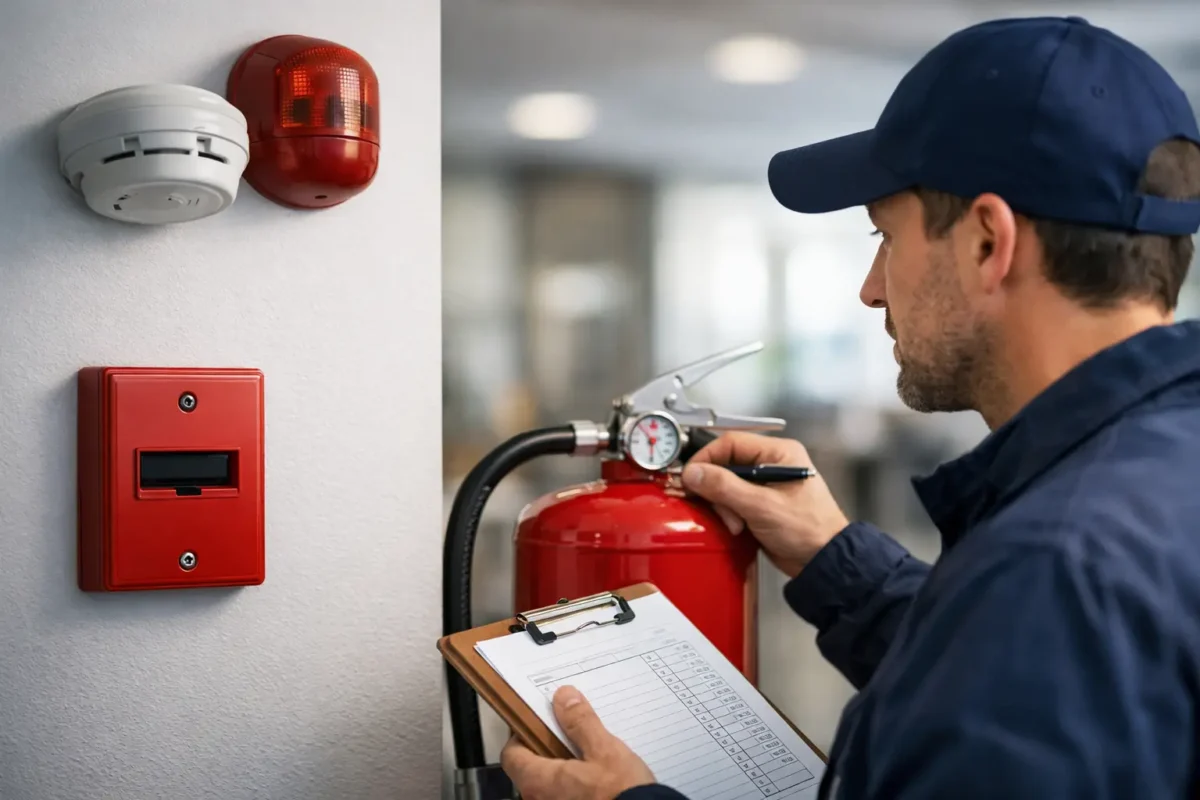
A fire alarm panel can look normal while a weak battery, dirty smoke detector, damaged pull station, or disconnected notification device is waiting to fail. That is why fire alarm inspections are not a paperwork exercise. They are a practical check that your building’s life-safety system can detect an emergency, alert occupants, and communicate the right signal when it counts.
For a daycare, a retail store, an apartment property, a warehouse, or an active job site, an alarm system that is installed correctly and inspected on schedule protects more than the building. It protects staff, customers, tenants, inventory, operating continuity, and the confidence that comes from knowing a life-safety system is being managed rather than ignored.
What Fire Alarm Inspections Actually Check
An inspection is a structured review of the system’s condition, records, and visible components. The exact scope depends on the building, installed equipment, local requirements, and the authority having jurisdiction, often called the AHJ. A small owner-operated shop will not have the same system or inspection demands as a multi-story commercial property with sprinklers, elevator recall, and a monitored fire alarm network.
Still, qualified service professionals commonly inspect the control panel, power supplies, backup batteries, initiating devices, notification appliances, annunciators, wiring conditions, monitoring connections, and required documentation. They look for trouble signals, physical damage, missing labels, obstructed devices, expired batteries, construction dust, paint overspray, and signs that a prior renovation changed the space without updating the system.
A proper visit should produce a clear record of what was inspected, what passed, what needs correction, and what should be monitored. Facility managers need that record for compliance files, insurance discussions, property transactions, and ongoing service planning. More importantly, it gives them a usable list of priorities instead of a vague statement that the system is “fine.”
Inspection, Testing, and Maintenance Are Different Jobs
These terms are often used interchangeably, but they answer different questions.
An inspection asks whether devices and equipment appear to be in acceptable condition and whether required records are present. Testing verifies operation by activating selected components and confirming the expected response at the panel, notification appliances, supervising station, or connected equipment. Maintenance addresses deficiencies and performance issues, such as replacing a failing battery, cleaning a detector, repairing a circuit, or reprogramming the panel after a tenant improvement.
The distinction matters because a visual walkthrough alone does not prove that every horn, strobe, detector, pull station, or communication path will perform correctly. On the other hand, testing every system component without reviewing records and physical conditions can miss issues that create future failures.
For owners, the operational goal is straightforward: schedule the required inspection and testing intervals, correct deficiencies promptly, and keep the system aligned with the building’s actual layout and use. Your fire protection provider can confirm the schedule that applies to your equipment and local jurisdiction.
Why Buildings Fail Their Fire Alarm Inspections
Most deficiencies are not caused by a single catastrophic equipment failure. They develop through routine changes that no one connected back to the alarm system.
A remodel may add walls that block notification appliances or relocate a detector into a poor position. A ceiling repair may leave dust around a smoke detector. A tenant may stack inventory below a device, cover a pull station, or remove a protective cover without replacing it. Contractors may work near wiring and leave a device disconnected. Backup batteries naturally age, while control panels can accumulate trouble conditions that staff silence without arranging service.
Construction and job-site conditions deserve particular attention. Dust, changing floor plans, temporary power, exposed wiring, and frequent subcontractor activity can affect system components quickly. If the building is occupied during renovation, the risk becomes more complicated because the alarm system may need temporary protective measures and documented coordination while work is underway.
For multi-site operators, inconsistency is another common problem. One location maintains detailed service records while another relies on whoever is working that day to notice panel alerts. A centralized inspection calendar and a clear escalation process reduce that gap.
A Practical Readiness Check Between Service Visits
Building staff should not attempt to replace formal inspections or perform work outside their training. They can, however, identify visible concerns early and report them before the next scheduled visit.
Use a simple monthly walk-through to check for these conditions:
- The fire alarm control panel has no unexplained trouble, supervisory, or communication messages.
- Pull stations, detectors, horns, strobes, and visible wiring are not damaged, painted over, blocked, or missing.
- Storage, displays, decorations, or furniture have not been placed where they obstruct devices or access to alarm equipment.
- Recent construction, tenant changes, roof work, or network changes have been reported to the responsible fire alarm provider.
- Inspection tags, test records, and service reports are organized and available to the person responsible for the property.
If a panel displays a trouble condition, do not treat it as background noise. A trouble signal is the system telling you that a supervised condition needs attention. The right response depends on the message and the property, but it should lead to documented follow-up, not a permanent workaround.
How Often Should a Fire Alarm System Be Inspected?
There is no single schedule that fits every property. Required frequencies can vary based on the type of device, the system design, occupancy classification, adopted fire code, manufacturer requirements, monitoring arrangement, and direction from the local fire authority. Some tasks occur monthly, while others may be quarterly, semiannual, annual, or performed on longer cycles.
This is why copying a schedule from another business can create problems. A jewelry store with monitored intrusion and fire systems, a daycare with strict occupant-safety expectations, and a parking facility with distributed equipment may each have different operational needs. The requirement that matters is the one tied to your actual building and local jurisdiction.
Seattle-area and California property operators should also expect local enforcement practices to influence documentation and correction expectations. When in doubt, confirm the current requirement with a qualified fire alarm service provider and the appropriate authority rather than relying on an old inspection tag or a previous tenant’s records.
When an Inspection Should Lead to an Upgrade
Not every deficiency calls for a system replacement. Sometimes the right repair is a battery change, device cleaning, replacement horn/strobe, or correction to a circuit. But repeated trouble conditions, obsolete equipment, unavailable replacement parts, expansion needs, and major occupancy changes can make an upgrade the more sensible long-term decision.
An upgrade is especially worth evaluating when a business has added rooms, changed its floor plan, expanded into an adjacent suite, installed new access-control equipment, or needs better visibility into system status. Fire alarm infrastructure should be designed around the way people use the building now, not the way it was used ten years ago.
There are trade-offs. Retrofitting a legacy system may limit downtime and upfront cost, while a larger modernization can improve serviceability and support future expansion. The best option depends on code requirements, device condition, wiring pathways, budget, and how much disruption the operation can tolerate.
Plan Service Around Your Operation
Fire alarm testing can affect occupants, tenants, customers, and monitoring personnel, so coordination matters. A service visit should be planned around business hours, site access, notification procedures, and any special conditions such as sleeping occupants, children, sensitive inventory, or a facility that cannot pause operations easily.
Before work begins, make sure the service team knows who controls access, who should receive updates, whether a monitoring center must be notified, and which areas have changed since the last visit. After service, review the report with the same attention you would give a security incident report. Open deficiencies need an owner, a target date, and a documented resolution.
Tech Security USA helps property owners and businesses plan business-grade protection infrastructure with system design guidance, installation coordination, and responsive support. For fire alarm work, the right starting point is a site-specific review that accounts for your existing equipment, local requirements, and daily operation.
A fire alarm system is easy to forget when it is quiet. Keep it that way by treating inspection records, trouble signals, and needed repairs as active facility responsibilities – before an emergency turns a small unresolved issue into a critical failure.
Posted on GoogleTrustindex verifies that the original source of the review is Google. I visited the Tech Security USA orange to install security cameras for my home. I found it a very professional company, with high quality products that were made me impressed. I recommend it to anyone who are looking a professional security cameras company in onrange city of Orange County CA.Posted on GoogleTrustindex verifies that the original source of the review is Google. “Edit (this review is not “spam” which the owner claims it is and the story is absolutely real however it was about 2 years ago and if I wasn’t shy back then(9th grade) or I wish I had done/said something about my dad and I being taken advantage of as it was a scam (quoted at around $150 but after having to wait 3weeks instead of 3 days for the guy to charge us $300 for a cheap screen that no longer had a haptic button or working Touch ID along with many white pressure dots along the edges). Do not go here. If you look at most of their 5-star reviews, they are older than 7 years. I went here recently to fix my iPad Air (3rd gen). The problem was the screen's backlight wouldn't work, so it would just show a black image. The technician said he could get it done for around $150 and in 2-3 days he would call us (my dad and I). After a week of waiting, we decided to call but to no avail. We went to the place to check up on the work done, if any. We got there and the iPad was in the exact same spot as the day we left it there. The guy told us it would be ready in about 4 days, no later, and that he would call us. We never got the call, so we went back after about another 3 days of waiting for a call (2 weeks now). After waiting, we went back to the store for the iPad, and it appeared to us as if he had just gotten started by breaking the screen to replace it. After another week, we came back and he pulled it out from a drawer saying something along the lines of, "I was about to call you guys." The screen was working, but it was clearly a cheap screen that was ordered online, and the Touch ID didn’t work anymore. The button was replaced with a non-haptic one. There are many white dots along the edges of the screen that look as if someone pressed their thumb down too hard for too long. The guy said with all the "extra" work done to it, the new total would be $300. When my dad and I looked at each other, we knew that wasn’t right, but I watched my dad grab his wallet and pay. I wish I had said something because we were taken advantage of, and after a week, the iPad's screen isn’t functioning properly as it feels unresponsive.Posted on GoogleTrustindex verifies that the original source of the review is Google. Will somebody please tell the owner to stop responding? She’s only validating the bad reviews.Posted on GoogleTrustindex verifies that the original source of the review is Google. Little messy inside but brought an old Moto Z2 Play in to finalize my failed battery self install. Done when promised, phone looked as good as new and works fine. I'm happy.Posted on GoogleTrustindex verifies that the original source of the review is Google. Garbage screen quality do not come here the screen is more different then a regular apple screen they use low quality screens the whole screen shattered and has black lines throughout it after a tiny drop with a screen protector.Posted on GoogleTrustindex verifies that the original source of the review is Google. I needed a battery replacement for my Huawei p10, the engineer fixed it in a few days (he had to order the battery) and it was reasonable priced, very good, thank youPosted on GoogleTrustindex verifies that the original source of the review is Google. Great location and employees. Really came through when I needed help. Recommend this place to anyone.Posted on GoogleTrustindex verifies that the original source of the review is Google. My go to place for any laptop and iPhone repairs. Also very friendly and experienced guy James.
Resent Posts
How to Design Jobsite Surveillance That Works
21 October 2026
Surveillance System Maintenance Guide for Uptime
19 October 2026
Table of Contents