
How to Install Fire Alarms for Homes and Businesses
[yasr_overall_rating]
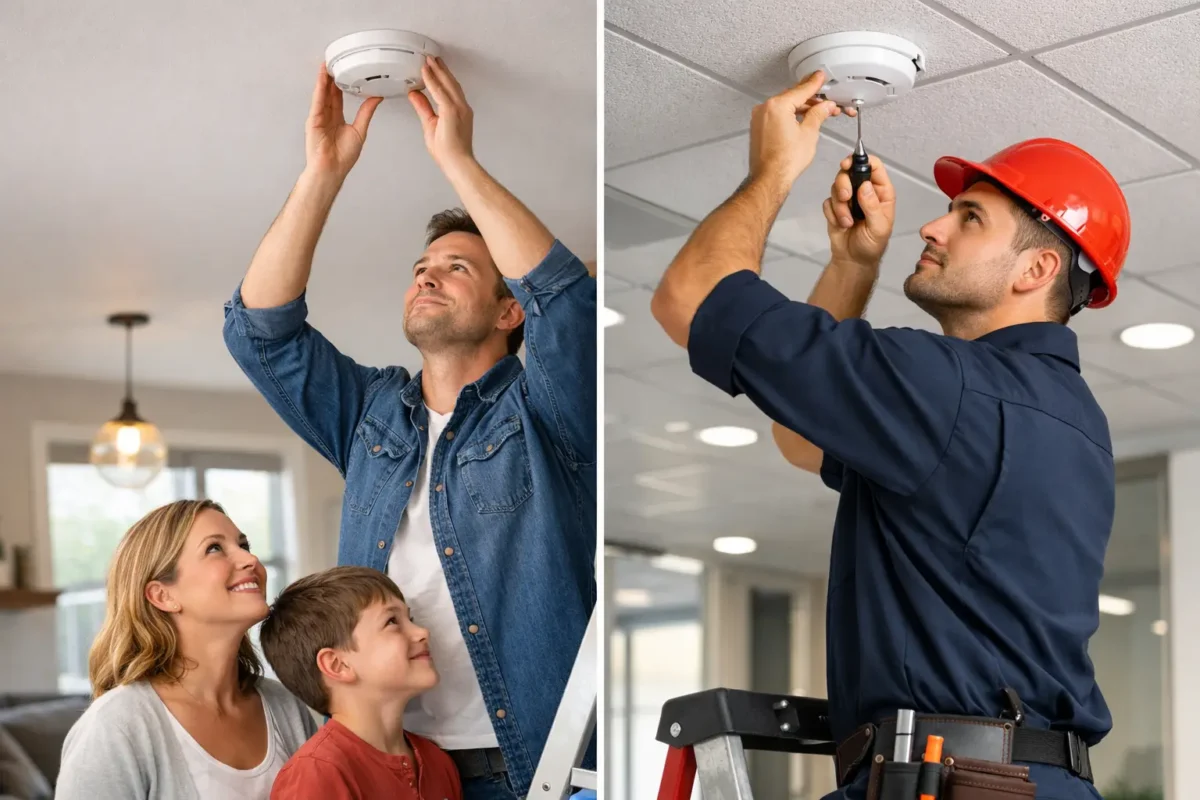
A fire alarm only helps if it detects danger early enough for people to act. That makes placement, power, and testing just as critical as the device itself. If you are researching how to install fire alarms, start with the property layout and the applicable local requirements – not the box on the shelf.
For a single-family home, a properly selected smoke alarm system may be a manageable project. For a daycare, retail shop, multifamily property, warehouse, or other commercial site, fire alarm installation is typically a permitted life-safety project that should be designed and completed by qualified professionals. The right approach depends on occupancy type, building size, existing wiring, local fire code, and whether the system must report alarms to a monitoring center.
Start With the Right Type of Fire Alarm
“Fire alarm” can describe several different devices. Smoke alarms are common in homes and detect combustion particles. Heat detectors respond to temperature changes and can be useful in areas where smoke or steam would create nuisance alarms. Carbon monoxide alarms detect a different hazard and are often required in sleeping areas or near fuel-burning appliances, but they do not replace smoke detection.
A commercial fire alarm system may include smoke or heat detectors, manual pull stations, horn-strobes, control panels, backup batteries, notification devices, sprinkler monitoring, and remote monitoring communications. These components must operate as one supervised system. Replacing or adding a device without confirming panel compatibility, circuit capacity, and programming can leave an issue that only appears during an emergency or inspection.
For most residences, choose interconnected alarms with battery backup. When one alarm activates, every connected alarm sounds, giving occupants more time to respond. Hardwired interconnected units are often the strongest choice during new construction or major remodeling. Wireless interconnected models can be practical where running cable would require opening finished walls, provided all devices are compatible and installed according to the manufacturer’s instructions.
How to Install Fire Alarms in the Right Locations
Good placement is the difference between early warning and a late alert. Follow the manufacturer’s instructions and local requirements first, since they control the minimum distance from walls, ceiling features, cooking equipment, and air vents.
In a typical home, install smoke alarms inside every sleeping room, outside each separate sleeping area, and on every level of the home, including the basement. Large homes, split-level layouts, and long hallways may need additional devices so an alarm is audible throughout the building. Mount alarms on the ceiling whenever possible, or high on a wall when ceiling mounting is not allowed by the device instructions.
Avoid locations that cause false alarms or interfere with detection. Do not place smoke alarms directly beside cooking appliances, inside bathrooms, near forced-air supply vents, next to ceiling fans, or in dusty, humid, or insect-prone spaces. Kitchens often benefit from a heat detector or a smoke alarm placed at the code-approved distance from cooking equipment. Garages, unfinished attics, and utility rooms also may call for heat detection instead of a standard smoke alarm, depending on conditions and code requirements.
Commercial placement requires a site-specific plan. A smoke shop, for example, may have environmental conditions that affect detector selection. A daycare must account for sleeping rooms, corridors, staff areas, and the need for clear audible and visible notification. In a warehouse or construction environment, ceiling height, dust, temperature swings, and equipment operation can make conventional spot smoke detection a poor fit. This is where a designed fire alarm system matters more than simply adding more devices.
Check Code, Permits, and Existing System Requirements
Fire alarm rules are not one-size-fits-all. Requirements can vary by city, county, state, occupancy classification, insurance carrier, and the age of the building. Seattle and California properties may have additional local interpretations, permitting steps, or inspection requirements beyond baseline building and fire codes.
Before drilling, verify whether the work requires a permit and whether a licensed fire alarm contractor is required. This is particularly relevant when work involves a commercial fire alarm control panel, notification circuits, sprinkler supervisory devices, elevator recall, fire doors, or central-station monitoring. A homeowner can often replace an existing listed residential alarm with a compatible unit, but adding new hardwired circuits or modifying a commercial system is a different level of work.
If the building already has a panel, identify its manufacturer, model, device type, wiring class, and available capacity. Do not assume that a detector, pull station, or horn-strobe from another brand will work correctly. Fire alarm components are listed for specific system combinations. Mixing equipment can create trouble conditions, failed inspections, or devices that do not activate as intended.
Install Residential Alarms With Power Reliability in Mind
For battery-only alarms, use the mounting plate supplied by the manufacturer, secure it to a stable ceiling or wall surface, install the specified battery, and twist the device into place. Test it immediately using the test button. Label the installation date so replacement timing is easy to track.
For hardwired residential alarms, turn off the correct circuit at the electrical panel and verify power is off before handling wires. The alarm typically connects to line power, neutral, and an interconnect conductor, but wire colors and connector styles vary. Follow the device diagram exactly and use only units approved for the existing interconnect system. If the wiring is damaged, uncertain, or not code-compliant, bring in a licensed electrician rather than guessing behind a ceiling box.
Battery backup is not optional just because an alarm is hardwired. Power outages can happen during storms, electrical faults, or fire-related damage. Install the approved backup battery, restore circuit power, and test every connected alarm. When one device is tested, the others should sound if the system is properly interconnected.
Commission the System Before You Rely on It
Installation is not complete when the alarm is mounted. Test every device, confirm audibility in closed bedrooms and occupied work areas, and make sure strobe coverage is appropriate where required. For commercial systems, commissioning should also verify panel status, trouble reporting, battery condition, notification appliances, monitoring transmission, and documentation.
A test button confirms that an alarm can sound, but it does not always prove the sensor is responding properly. Use an approved smoke or heat test method where the manufacturer calls for it. Never test a smoke detector with an open flame, burning paper, aerosol products not made for detector testing, or heavy smoke from a candle. Those shortcuts can damage equipment, contaminate sensors, and create an unnecessary fire risk.
Document device locations, model numbers, installation dates, test results, and battery replacement schedules. Facility managers should keep this record with other life-safety documentation. It makes annual inspections, service calls, remodel planning, and troubleshooting much faster.
Maintain Fire Alarms After Installation
Fire alarms need routine attention. Test residential alarms monthly, replace batteries when required by the manufacturer, and clean dust from exterior vents with a soft vacuum attachment or dry cloth. Replace the entire alarm at the end of its listed service life, commonly around 10 years for many residential smoke alarms. Check the date printed on the device rather than relying on appearance.
Commercial properties need scheduled inspection, testing, and maintenance based on the system type and local requirements. A system that shows a trouble signal, chirps repeatedly, has a disabled zone, or loses communication should be serviced promptly. Silencing a nuisance alarm without finding the cause is not a maintenance plan.
For homes and businesses that need dependable protection without uncertainty over placement, equipment compatibility, or permitting, Tech Security USA can help coordinate a business-grade fire alarm solution designed and installed correctly. The goal is simple: when a real emergency begins, the system must alert people clearly, quickly, and without hesitation.
Posted on GoogleTrustindex verifies that the original source of the review is Google. I visited the Tech Security USA orange to install security cameras for my home. I found it a very professional company, with high quality products that were made me impressed. I recommend it to anyone who are looking a professional security cameras company in onrange city of Orange County CA.Posted on GoogleTrustindex verifies that the original source of the review is Google. “Edit (this review is not “spam” which the owner claims it is and the story is absolutely real however it was about 2 years ago and if I wasn’t shy back then(9th grade) or I wish I had done/said something about my dad and I being taken advantage of as it was a scam (quoted at around $150 but after having to wait 3weeks instead of 3 days for the guy to charge us $300 for a cheap screen that no longer had a haptic button or working Touch ID along with many white pressure dots along the edges). Do not go here. If you look at most of their 5-star reviews, they are older than 7 years. I went here recently to fix my iPad Air (3rd gen). The problem was the screen's backlight wouldn't work, so it would just show a black image. The technician said he could get it done for around $150 and in 2-3 days he would call us (my dad and I). After a week of waiting, we decided to call but to no avail. We went to the place to check up on the work done, if any. We got there and the iPad was in the exact same spot as the day we left it there. The guy told us it would be ready in about 4 days, no later, and that he would call us. We never got the call, so we went back after about another 3 days of waiting for a call (2 weeks now). After waiting, we went back to the store for the iPad, and it appeared to us as if he had just gotten started by breaking the screen to replace it. After another week, we came back and he pulled it out from a drawer saying something along the lines of, "I was about to call you guys." The screen was working, but it was clearly a cheap screen that was ordered online, and the Touch ID didn’t work anymore. The button was replaced with a non-haptic one. There are many white dots along the edges of the screen that look as if someone pressed their thumb down too hard for too long. The guy said with all the "extra" work done to it, the new total would be $300. When my dad and I looked at each other, we knew that wasn’t right, but I watched my dad grab his wallet and pay. I wish I had said something because we were taken advantage of, and after a week, the iPad's screen isn’t functioning properly as it feels unresponsive.Posted on GoogleTrustindex verifies that the original source of the review is Google. Will somebody please tell the owner to stop responding? She’s only validating the bad reviews.Posted on GoogleTrustindex verifies that the original source of the review is Google. Little messy inside but brought an old Moto Z2 Play in to finalize my failed battery self install. Done when promised, phone looked as good as new and works fine. I'm happy.Posted on GoogleTrustindex verifies that the original source of the review is Google. Garbage screen quality do not come here the screen is more different then a regular apple screen they use low quality screens the whole screen shattered and has black lines throughout it after a tiny drop with a screen protector.Posted on GoogleTrustindex verifies that the original source of the review is Google. I needed a battery replacement for my Huawei p10, the engineer fixed it in a few days (he had to order the battery) and it was reasonable priced, very good, thank youPosted on GoogleTrustindex verifies that the original source of the review is Google. Great location and employees. Really came through when I needed help. Recommend this place to anyone.Posted on GoogleTrustindex verifies that the original source of the review is Google. My go to place for any laptop and iPhone repairs. Also very friendly and experienced guy James.
Resent Posts

How to Design Jobsite Surveillance That Works
21 October 2026
Surveillance System Maintenance Guide for Uptime
19 October 2026
Table of Contents