
What Cameras Work Without WiFi? Reliable Options
[yasr_overall_rating]

A camera system should not stop protecting your property because the Wi-Fi signal drops, a router is unplugged, or an internet provider has an outage. Property owners asking what cameras work without wifi usually need dependable recording at a site where wireless service is weak, unavailable, or simply not trusted for a primary security system. The good news is that many business-grade cameras work without Wi-Fi. The right choice depends on whether you need local recording, remote viewing, or coverage at a location with no fixed internet service.
What Cameras Work Without WiFi?
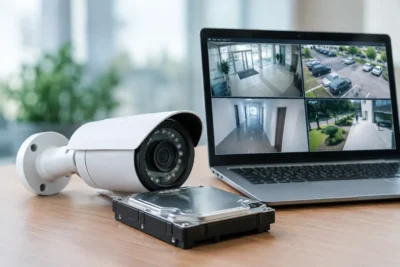
The most dependable answer is a wired camera system with local recording. PoE IP cameras connected to an NVR, or coaxial cameras connected to a DVR, do not rely on Wi-Fi to capture video. The cameras communicate over dedicated cable runs, and the recorder stores footage on hard drives installed at the property.
This setup remains functional during an internet outage. Cameras continue recording, motion alerts can be logged locally, and staff can review footage directly at the recorder or on a monitor connected to the system. If the recorder has backup power, the system can also continue operating during short power interruptions.
Wi-Fi and internet are often confused, but they are not the same thing. Wi-Fi is a local wireless connection. Internet service allows remote access from outside the property. A wired system can operate without either one. However, viewing live cameras from your phone while off-site generally requires an internet connection at the location.
PoE IP Cameras and NVRs
Power over Ethernet, commonly called PoE, is the preferred option for many commercial installations. One Ethernet cable provides both power and video data between each camera and the network video recorder. There is no need to run separate power wiring to every camera, and there is no dependence on a wireless signal at the camera.
PoE systems are a strong fit for retail stores, daycares, offices, parking areas, warehouses, and homes where cable can be installed correctly. They support high-resolution video, AI detection features, audio where appropriate, PTZ control, and organized local storage. A properly designed NVR system can operate on its own isolated camera network, which also reduces exposure to consumer-network issues.
The trade-off is installation. Cable pathways, camera placement, recorder location, and power protection need to be planned before the system goes in. For a multi-camera property, professional installation is usually the difference between a clean, reliable system and one that creates service problems later.
Coaxial Cameras and DVRs
Coaxial camera systems use traditional video cable, often RG59 or Siamese cable, to connect cameras to a digital video recorder. These systems are still practical for many properties, especially when existing coax wiring is already in place.
Modern HD-over-coax cameras can provide clear, usable video without Wi-Fi. A DVR records directly to local hard drives and can display cameras on a connected monitor. This is a cost-effective path for upgrades where replacing old analog cameras is necessary but running new Ethernet cable would add unnecessary labor.
Coax systems may have fewer advanced features than a well-specified IP camera system, depending on the equipment selected. Still, for entrances, cash-wrap areas, hallways, exterior doors, and general perimeter coverage, they remain a dependable no-Wi-Fi solution.
Cellular Cameras for Remote or Temporary Sites
Cellular security cameras use a 4G LTE or 5G data connection rather than Wi-Fi. They are useful when a camera needs remote access at a construction site, vacant lot, gate, utility area, temporary job site, or other location without wired internet.
These cameras do not need Wi-Fi, but they do need cellular coverage and an active data plan. That distinction matters. Continuous high-resolution recording can use significant data, so cellular cameras are often configured for motion-triggered recording, scheduled check-ins, or event-based remote viewing rather than nonstop cloud streaming.
For construction and job-site security, a cellular camera may be paired with solar power, battery power, or a dedicated power source. It can be an effective tool for documenting deliveries, monitoring equipment, and deterring unauthorized entry. But it should be selected based on real signal testing, expected activity, and the amount of footage the site needs to retain.
Cameras With SD Card Recording
Some cameras record directly to an internal microSD card. These models can capture video without Wi-Fi and may be useful for a small, targeted application such as monitoring a shed, detached garage, temporary indoor area, or a single entry point.
This approach has limits. SD cards provide less storage than a DVR or NVR hard drive, can be removed or damaged, and are not ideal as the only evidence source for a high-risk commercial location. If a camera is stolen, its local footage may be stolen with it. SD recording works best as a backup layer or for lower-risk coverage, not as the foundation of a full business security system.
How a No-WiFi Camera System Records Video
A no-Wi-Fi system needs a place to save video. In most professional installations, that place is an NVR or DVR located in a secure equipment area. The recorder should be positioned away from public access, connected to a properly sized hard drive, and protected by a battery backup where continuity is critical.
Retention time depends on several factors: the number of cameras, resolution, frame rate, recording schedule, motion activity, and hard-drive capacity. A jewelry store may need higher detail at display cases and transaction points. A parking facility may prioritize wide coverage and license plate capture at entrances. A daycare may need consistent coverage of controlled-access doors, classrooms, and exterior pickup areas while following privacy and placement requirements.
For most properties, the question is not simply whether a camera can record without Wi-Fi. It is whether the system is designed to preserve useful video for the number of days the business or homeowner actually needs. A camera that records a blurry image for two days is not a reliable incident-documentation system.
What You Lose Without Internet Access
Local recording does not require internet access, but certain convenience features do. Without an internet connection, you typically cannot receive off-site push alerts, view live video from your phone while away, receive remote technical support, or automatically back up footage to cloud storage.
That does not mean a system without internet is a poor choice. For many secure facilities, an isolated local system is intentional. It gives the owner direct control over recorded video and avoids making the camera network dependent on the office Wi-Fi.
If remote access is needed later, a business-grade router or cellular gateway can be added without converting cameras to Wi-Fi. The camera connections can remain wired and stable while the recorder receives a controlled path to the internet for authorized remote viewing.
Choosing the Right Camera Type for Your Property
Start with the location and the operational requirement. If you have power and can run cable, a PoE camera and NVR system is usually the strongest long-term choice. It delivers reliable recording, supports expansion, and is suited to properties where clear footage may be needed for theft investigations, liability claims, or staff safety.
If a building already has usable coax cable, a DVR upgrade can deliver reliable coverage without the cost of a complete rewire. For an off-grid or temporary site, cellular cameras may be the better fit, provided the data plan, signal strength, and power source are planned correctly. SD-card cameras are best reserved for limited applications or as supplementary coverage.
Camera placement matters as much as camera type. A high-quality camera pointed at a bright window, mounted too high, or aimed across a poorly lit parking lot may not deliver usable identification. Entrances, exits, cash areas, loading zones, vehicle lanes, gates, and blind spots should be evaluated individually before equipment is selected.
Design for Recording First, Remote Viewing Second
The most reliable security systems are designed around evidence capture. That means stable camera connections, appropriate lenses and resolution, adequate night performance, protected recording equipment, and enough storage for the required retention period. Remote phone viewing is valuable, but it should not be the only reason a system works.
For a home, business, job site, or multi-location operation, Tech Security USA can help match the camera platform, recorder, cabling, and support plan to the conditions on-site. A system designed and installed correctly can keep recording when Wi-Fi is unavailable and still give you a practical path to remote access when the operation requires it.
Posted on GoogleTrustindex verifies that the original source of the review is Google. I visited the Tech Security USA orange to install security cameras for my home. I found it a very professional company, with high quality products that were made me impressed. I recommend it to anyone who are looking a professional security cameras company in onrange city of Orange County CA.Posted on GoogleTrustindex verifies that the original source of the review is Google. “Edit (this review is not “spam” which the owner claims it is and the story is absolutely real however it was about 2 years ago and if I wasn’t shy back then(9th grade) or I wish I had done/said something about my dad and I being taken advantage of as it was a scam (quoted at around $150 but after having to wait 3weeks instead of 3 days for the guy to charge us $300 for a cheap screen that no longer had a haptic button or working Touch ID along with many white pressure dots along the edges). Do not go here. If you look at most of their 5-star reviews, they are older than 7 years. I went here recently to fix my iPad Air (3rd gen). The problem was the screen's backlight wouldn't work, so it would just show a black image. The technician said he could get it done for around $150 and in 2-3 days he would call us (my dad and I). After a week of waiting, we decided to call but to no avail. We went to the place to check up on the work done, if any. We got there and the iPad was in the exact same spot as the day we left it there. The guy told us it would be ready in about 4 days, no later, and that he would call us. We never got the call, so we went back after about another 3 days of waiting for a call (2 weeks now). After waiting, we went back to the store for the iPad, and it appeared to us as if he had just gotten started by breaking the screen to replace it. After another week, we came back and he pulled it out from a drawer saying something along the lines of, "I was about to call you guys." The screen was working, but it was clearly a cheap screen that was ordered online, and the Touch ID didn’t work anymore. The button was replaced with a non-haptic one. There are many white dots along the edges of the screen that look as if someone pressed their thumb down too hard for too long. The guy said with all the "extra" work done to it, the new total would be $300. When my dad and I looked at each other, we knew that wasn’t right, but I watched my dad grab his wallet and pay. I wish I had said something because we were taken advantage of, and after a week, the iPad's screen isn’t functioning properly as it feels unresponsive.Posted on GoogleTrustindex verifies that the original source of the review is Google. Will somebody please tell the owner to stop responding? She’s only validating the bad reviews.Posted on GoogleTrustindex verifies that the original source of the review is Google. Little messy inside but brought an old Moto Z2 Play in to finalize my failed battery self install. Done when promised, phone looked as good as new and works fine. I'm happy.Posted on GoogleTrustindex verifies that the original source of the review is Google. Garbage screen quality do not come here the screen is more different then a regular apple screen they use low quality screens the whole screen shattered and has black lines throughout it after a tiny drop with a screen protector.Posted on GoogleTrustindex verifies that the original source of the review is Google. I needed a battery replacement for my Huawei p10, the engineer fixed it in a few days (he had to order the battery) and it was reasonable priced, very good, thank youPosted on GoogleTrustindex verifies that the original source of the review is Google. Great location and employees. Really came through when I needed help. Recommend this place to anyone.Posted on GoogleTrustindex verifies that the original source of the review is Google. My go to place for any laptop and iPhone repairs. Also very friendly and experienced guy James.
Resent Posts
How to Design Jobsite Surveillance That Works
21 October 2026
Surveillance System Maintenance Guide for Uptime
19 October 2026
Table of Contents