
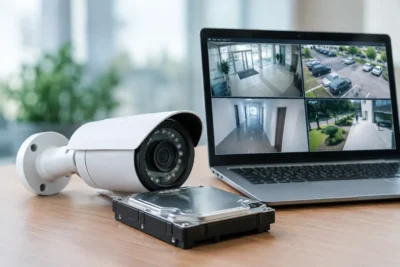
Wired Versus Wireless Surveillance for Business
[yasr_overall_rating]

A camera that misses the moment a cash drawer is opened, a vehicle enters a lot, or an employee needs help is not a security system. It is an expensive blind spot. The wired versus wireless surveillance decision directly affects whether your cameras stay online, deliver usable footage, and continue performing when your operation gets busy.
For most commercial properties, the best answer is not simply “wired is better” or “wireless is easier.” The right system depends on the building, the coverage area, the network, the available power, and how much evidence you need when an incident occurs. A system designed and installed correctly considers all of those factors before the first camera is mounted.
Wired Versus Wireless Surveillance Starts With the Job
Wired surveillance usually means IP cameras connected to a network video recorder, or NVR, through Ethernet cable. In many business-grade installations, that same cable provides both data and power through Power over Ethernet, commonly called PoE. Each camera receives a stable connection without relying on the property’s Wi-Fi signal or a separate outlet at the camera location.
Wireless surveillance cameras transmit video over Wi-Fi, a dedicated wireless bridge, or cellular connectivity. They can reduce cabling work in the right environment, especially where opening walls, trenching, or running cable across a temporary site would be impractical. However, “wireless” often refers only to the data connection. Most fixed wireless cameras still need local electrical power unless they are battery or solar-powered.
That distinction matters. A wireless camera mounted high on a parking lot pole may still require power installation, network planning, weatherproof equipment, and professional aiming. Eliminating one cable does not eliminate the need for a sound security design.
Why Wired Systems Are the Commercial Standard
A wired PoE system is usually the strongest choice for businesses that need continuous recording, high-resolution video, multiple cameras, and dependable remote access. Ethernet provides consistent bandwidth, which becomes more valuable as camera counts and image quality increase.
A jewelry store, smoke shop, daycare, warehouse, or office often needs clear footage at entrances, registers, hallways, storage areas, and exterior doors. When cameras are recording around the clock, a dedicated wired connection avoids competition with staff phones, customer Wi-Fi, point-of-sale equipment, and other devices that can slow down a shared wireless network.
Wired systems also make scaling more predictable. A properly sized PoE switch, NVR, cable pathway, and storage plan can support additional cameras as the operation grows. For a multi-site business, standardizing that infrastructure helps make monitoring, maintenance, and user training easier across locations.
What wired surveillance does well
Wired cameras are particularly effective when video quality is non-negotiable. They support high-resolution AI cameras, PTZ cameras, license plate recognition, panoramic views, and long recording schedules without placing the same strain on a wireless network.
They are also more resistant to interference. Wi-Fi can be affected by concrete walls, metal shelving, neighboring networks, microwave equipment, and changes in a building’s layout. A hardwired connection is not immune to every failure, but it removes many common causes of dropped cameras and unstable video streams.
For properties with existing cable routes or accessible ceilings, wired installation can also be more cost-effective over the system’s life. The initial labor may be higher, but the result is typically easier to service and less dependent on consumer-grade networking equipment.
The trade-off with wired systems
The main consideration is installation access. Running cable through a finished retail space, historic building, large warehouse, or detached structure requires planning. Long distances may require fiber, network extenders, wireless bridges, or additional equipment to maintain performance.
A quality installer also has to plan cable paths, weatherproof penetrations, surge protection, rack space, backup power, and the location of the recorder. These are not reasons to avoid wired surveillance. They are reasons to design it properly instead of treating cameras as an off-the-shelf purchase.
When Wireless Surveillance Makes Sense
Wireless cameras solve real problems when cable installation is disruptive, temporary, or physically difficult. A construction site is a common example. Cameras may need to move as the project changes, and temporary internet service may be delivered through LTE or 5G routers. A managed wireless deployment can provide visibility over gates, equipment yards, material storage, and site activity without building permanent infrastructure that will be removed later.
Wireless can also be a practical option for a detached garage, a remote gate, a small office addition, or an exterior location where trenching cable would be costly. In these cases, a point-to-point wireless bridge can be more dependable than a standard Wi-Fi camera because it creates a dedicated connection between two locations.
For residential customers, wireless cameras can work well for limited coverage where the home network is strong and the camera location has dependable power. They are often a convenient addition to a larger wired system, such as adding coverage to a side yard or detached structure.
Where wireless systems fall short
Wireless surveillance is only as reliable as the network supporting it. If the Wi-Fi signal is weak, overloaded, or interrupted, the camera may lose video, delay alerts, or reconnect at a lower quality setting. This can be especially frustrating when several cameras are sharing one access point.
Battery-powered cameras add another layer of compromise. They are useful for temporary coverage and locations with no power, but they generally rely on motion-triggered recording rather than constant recording. Frequent activity can drain batteries quickly, while poor motion settings can create gaps or unnecessary alerts.
Wireless cameras can also be vulnerable to changes outside your control. A new tenant may install equipment that creates interference. A router may be replaced without preserving settings. An internet outage may affect remote viewing or cloud-based functions. For an area that needs evidentiary video all day, every day, a wired connection is usually the safer operational choice.
Match the System to Your Risk Areas
The best surveillance systems use different connection methods where each one makes sense. A single-property answer does not always fit every camera location.
For example, a daycare may use wired indoor cameras for classrooms, entry points, and administrative areas, where continuous recording and dependable playback are essential. A wireless bridge may extend coverage to a detached play area if trenching is not practical. A jewelry store may prioritize wired high-resolution cameras above showcases, registers, safes, and exterior approaches, while using a specialized camera at the entrance to capture faces and vehicle activity.
Parking facilities often need wired cameras at gates, payment equipment, and building entrances, plus properly engineered wireless links for distant poles or perimeter locations. Construction managers may need a cellular-connected job-site camera package that can be relocated quickly, then transition to permanent wired coverage once a building is complete.
The key is to identify what each camera must accomplish. Deterrence, live viewing, incident investigation, license plate capture, employee safety, and remote management all require different placement, resolution, lighting, and recording standards.
Questions to Answer Before You Buy
Before selecting wired or wireless cameras, assess the property in practical terms. How many cameras will record at the same time? Do you need 24/7 recording or only motion events? Is there accessible cable pathway above ceilings, through crawl spaces, or between buildings? Are there weak Wi-Fi zones, concrete walls, metal structures, or heavy customer traffic on the network?
You should also decide where footage will be stored and how long it must be retained. A local NVR offers control, predictable recording, and fast access to footage on-site. Cloud storage can add off-site access and redundancy, but it may introduce recurring fees and depends on available upload bandwidth. Many commercial systems use local recording with appropriate remote access rather than relying exclusively on the cloud.
Do not overlook power protection. Cameras, PoE switches, recorders, routers, and wireless bridges should be protected with properly sized battery backup and surge protection. A short outage should not automatically take every security camera offline.
Installation Quality Is Part of the Security System
Camera hardware matters, but installation quality determines much of the real-world result. A high-resolution camera cannot compensate for a poor viewing angle, glare from exterior lighting, improper cable termination, weak wireless signal, or insufficient storage.
A professional site review can identify the conditions that online product descriptions cannot see: vehicle approach angles, face capture distances, lighting changes, obstructions, mounting height, network limitations, and local power availability. It also helps prevent a common mistake: buying cameras first and trying to force them into unsuitable locations later.
Tech Security USA helps property owners and businesses build business-grade systems around the site, not around a one-size-fits-all camera package. That includes equipment selection, custom design guidance, installation coordination, training, and same day support when operations cannot wait.
Choose wired surveillance when your priority is continuous recording, high-quality evidence, and long-term expansion. Choose wireless when the location, timeline, or construction conditions make cabling impractical, but only after confirming that power and network performance will support the cameras. The camera that protects your property is the one that remains connected, correctly positioned, and ready when the footage matters most.
Posted on GoogleTrustindex verifies that the original source of the review is Google. I visited the Tech Security USA orange to install security cameras for my home. I found it a very professional company, with high quality products that were made me impressed. I recommend it to anyone who are looking a professional security cameras company in onrange city of Orange County CA.Posted on GoogleTrustindex verifies that the original source of the review is Google. “Edit (this review is not “spam” which the owner claims it is and the story is absolutely real however it was about 2 years ago and if I wasn’t shy back then(9th grade) or I wish I had done/said something about my dad and I being taken advantage of as it was a scam (quoted at around $150 but after having to wait 3weeks instead of 3 days for the guy to charge us $300 for a cheap screen that no longer had a haptic button or working Touch ID along with many white pressure dots along the edges). Do not go here. If you look at most of their 5-star reviews, they are older than 7 years. I went here recently to fix my iPad Air (3rd gen). The problem was the screen's backlight wouldn't work, so it would just show a black image. The technician said he could get it done for around $150 and in 2-3 days he would call us (my dad and I). After a week of waiting, we decided to call but to no avail. We went to the place to check up on the work done, if any. We got there and the iPad was in the exact same spot as the day we left it there. The guy told us it would be ready in about 4 days, no later, and that he would call us. We never got the call, so we went back after about another 3 days of waiting for a call (2 weeks now). After waiting, we went back to the store for the iPad, and it appeared to us as if he had just gotten started by breaking the screen to replace it. After another week, we came back and he pulled it out from a drawer saying something along the lines of, "I was about to call you guys." The screen was working, but it was clearly a cheap screen that was ordered online, and the Touch ID didn’t work anymore. The button was replaced with a non-haptic one. There are many white dots along the edges of the screen that look as if someone pressed their thumb down too hard for too long. The guy said with all the "extra" work done to it, the new total would be $300. When my dad and I looked at each other, we knew that wasn’t right, but I watched my dad grab his wallet and pay. I wish I had said something because we were taken advantage of, and after a week, the iPad's screen isn’t functioning properly as it feels unresponsive.Posted on GoogleTrustindex verifies that the original source of the review is Google. Will somebody please tell the owner to stop responding? She’s only validating the bad reviews.Posted on GoogleTrustindex verifies that the original source of the review is Google. Little messy inside but brought an old Moto Z2 Play in to finalize my failed battery self install. Done when promised, phone looked as good as new and works fine. I'm happy.Posted on GoogleTrustindex verifies that the original source of the review is Google. Garbage screen quality do not come here the screen is more different then a regular apple screen they use low quality screens the whole screen shattered and has black lines throughout it after a tiny drop with a screen protector.Posted on GoogleTrustindex verifies that the original source of the review is Google. I needed a battery replacement for my Huawei p10, the engineer fixed it in a few days (he had to order the battery) and it was reasonable priced, very good, thank youPosted on GoogleTrustindex verifies that the original source of the review is Google. Great location and employees. Really came through when I needed help. Recommend this place to anyone.Posted on GoogleTrustindex verifies that the original source of the review is Google. My go to place for any laptop and iPhone repairs. Also very friendly and experienced guy James.
Resent Posts
How to Design Jobsite Surveillance That Works
21 October 2026
Surveillance System Maintenance Guide for Uptime
19 October 2026
Table of Contents