
Where PTZ Cameras Deliver Real Security Value
[yasr_overall_rating]
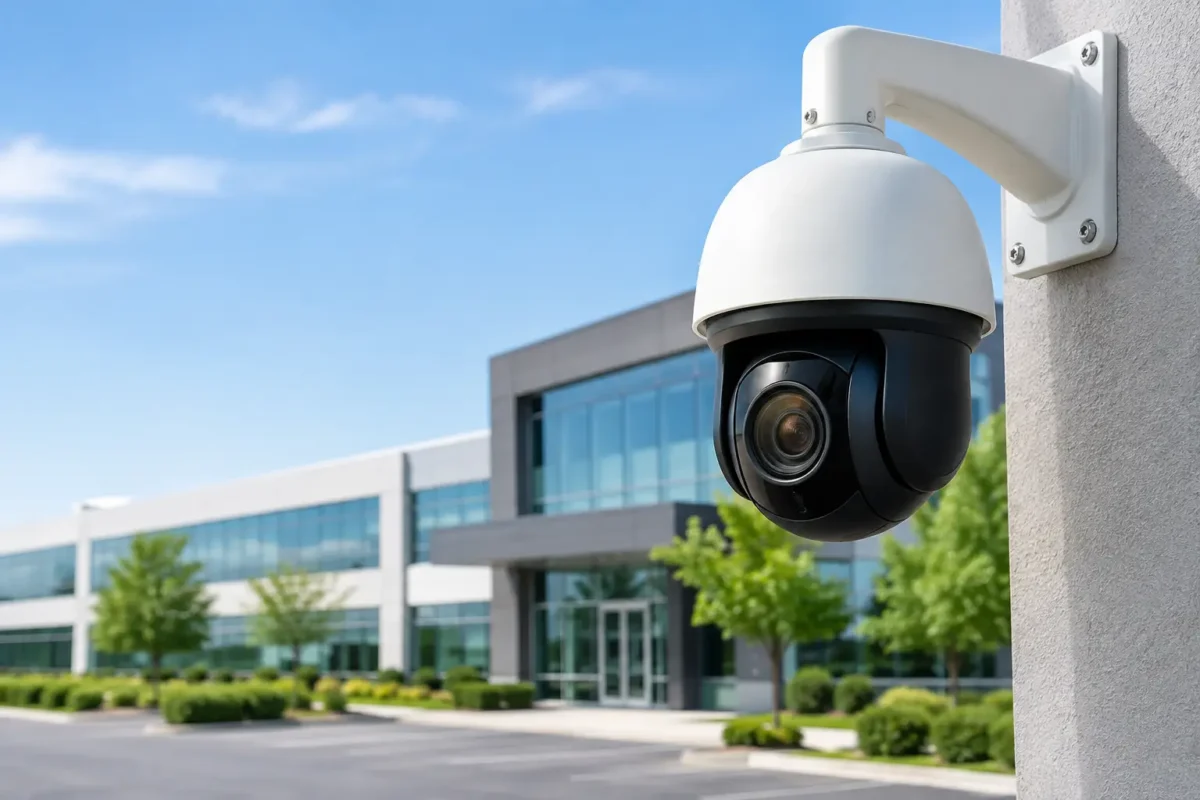
A parking lot incident rarely happens directly beneath a fixed camera. It starts at the edge of the property, moves through a drive aisle, or unfolds near an entrance where identification matters most. PTZ cameras are built for these situations because they give an operator the ability to pan across a scene, tilt toward activity, and zoom in for detail without installing a separate camera for every possible viewpoint.
That flexibility is valuable, but it does not make a PTZ camera the right answer for every location. A well-designed system uses PTZ coverage where active monitoring, long-distance detail, and visible deterrence matter. It also keeps fixed cameras in place to record the areas a PTZ may be looking away from at any given time.
What PTZ Cameras Do Differently
PTZ stands for pan, tilt, and zoom. Unlike a fixed bullet, turret, or dome camera, a PTZ model can move horizontally, move vertically, and use optical zoom to bring distant subjects closer. Many business-grade models can be controlled manually through a recorder, computer, mobile app, or security operations center. They can also run scheduled patrols, return to preset positions, or respond to event triggers.
Optical zoom is the feature that often separates a PTZ from a standard wide-angle camera. Digital zoom simply enlarges pixels already captured in an image. Optical zoom uses the camera lens to capture more usable detail at distance. For a large lot, loading area, construction site, or perimeter, that distinction can determine whether footage helps identify a vehicle, person, or activity.
PTZ cameras also create a strong visible deterrent. When a camera is clearly installed on a pole, building corner, or elevated mount, people recognize that the property has active surveillance. In higher-risk environments, that presence can discourage trespassing, dumping, theft, and after-hours loitering before an incident escalates.
The Best Uses for PTZ Cameras
PTZ coverage works best when a property has a broad area that needs attention but does not have a single, predictable point of activity. Parking facilities are a clear example. A fixed camera may cover entrance and exit lanes, while a PTZ can observe drive aisles, pedestrian paths, distant rows, and suspicious activity as it develops.
For smoke shops, jewelry stores, and other retail locations with higher theft exposure, a PTZ can provide management with better visibility across the storefront, exterior approaches, and parking area. Indoors, it may be useful in a large sales floor or warehouse. However, fixed cameras should still cover cash wraps, display cases, entrances, and other critical areas continuously.
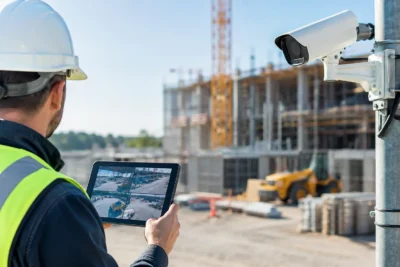
Construction and job-site security is another strong application. Sites change as materials arrive, equipment moves, and crews work in different zones. A PTZ camera on a properly designed elevated mount can survey the overall property, investigate alerts, and document work progress. When paired with fixed perimeter cameras, intrusion detection, lighting, and reliable connectivity, it becomes part of a practical job-site protection plan.
Daycares and schools require a more careful approach. A PTZ can help staff monitor larger exterior areas, arrival zones, playground perimeters, and parking lots. Camera placement, privacy policies, retention settings, and access controls must be considered from the beginning. The goal is accountable safety coverage, not unnecessary surveillance in sensitive spaces.
Why PTZ Cameras Should Not Work Alone
A PTZ camera can only face one direction at a time. This is the most important limitation to understand before buying one. If the camera turns to follow activity on the west side of a lot, it may not be recording usable detail at the east gate. That is why a PTZ should be part of a layered camera design rather than the entire design.
Fixed cameras provide continuous views of entrances, registers, gates, doors, walkways, and other priority areas. PTZ cameras add flexible observation and close-up investigation. Together, they provide better coverage than either format alone.
For many properties, the most reliable layout includes fixed cameras for documentation, one or more PTZ units for active observation, and a recorder sized for the required camera count and retention period. The right balance depends on the site, risk level, lighting, distance, and whether someone will actively monitor live video.
Choosing the Right PTZ Camera for Your Property
The camera body is only one part of the decision. A model that looks similar on a spec sheet may perform very differently depending on its zoom range, image sensor, low-light capability, mounting hardware, and network connection.
Start with distance. A camera watching a small storefront entrance does not need the same zoom range as one installed above a five-acre parking lot. Longer optical zoom can capture detail farther away, but it also requires a stable mount and a clear line of sight. Trees, signage, poles, parked vehicles, and bright backlighting can all limit real-world performance.
Night coverage deserves equal attention. Low-light imaging, infrared illumination, supplemental lighting, and scene conditions affect how useful video will be after dark. A PTZ may zoom in tightly during the day but lose useful color or facial detail at night if the area is poorly lit. For vehicle identification and license plate coverage, camera placement and purpose-built equipment often matter more than adding more zoom.
Consider how the camera will be used. If a manager or guard will actively monitor video, manual controls and preset positions should be easy to use. If no one will watch live feeds consistently, scheduled tours, motion-based alerts, auto-tracking features, and fixed camera coverage become more important. AI detection can help reduce unnecessary alerts by distinguishing people and vehicles from routine movement, but every setting should be tested on-site to avoid missed events or excessive notifications.
A business-grade PTZ should also be selected for its environment. Outdoor models need weather protection, appropriate operating temperature ratings, surge protection, and secure mounting. In coastal, rainy, or windy locations, the installation method is just as important as the camera rating.
Installation Details That Affect Performance
A poorly positioned PTZ can create expensive blind spots. Mounting height needs to provide a clear view while still allowing the camera to capture meaningful detail. Too low, and the camera becomes easier to tamper with. Too high, and the viewing angle may make faces, vehicle features, and event details harder to see.
Power and networking should be planned before equipment arrives. Most professional PTZ cameras use Power over Ethernet, while larger models may require higher-power PoE standards, dedicated power, or fiber connectivity for long runs. A weak wireless bridge, undersized network switch, or unreliable cellular connection can limit video quality and camera responsiveness.
Recording capacity must match the system plan. PTZ cameras can generate substantial data, especially at high resolution and frame rates. Retention requirements should account for all cameras, not just the PTZ. A property that needs 30 days of usable footage requires the right recorder, hard drive capacity, camera settings, and remote access configuration from day one.
Cybersecurity also belongs in the installation scope. Default passwords, open remote access, outdated firmware, and unsecured network devices create avoidable risk. Equipment should be configured with unique credentials, controlled user permissions, current firmware, and a documented support path.
Getting a System Designed and Installed Correctly
The most effective PTZ deployment begins with a site review. Before selecting a camera, identify the areas where incidents occur, the distance to the target zone, the lighting conditions, available mounting points, and the network path back to the recorder. This prevents the common mistake of buying a high-powered PTZ and expecting it to compensate for poor placement or missing fixed coverage.
Tech Security USA helps property owners and businesses match business-grade camera hardware to the way their sites actually operate. That may mean a single PTZ covering a large exterior area, or a larger design that combines PTZ units with fixed cameras, intrusion alarms, remote access, recording, installation coordination, and same-day support when it is needed.
Ask for a plan that explains what each camera is meant to capture. A clear design should identify continuous coverage areas, active observation zones, expected identification distances, storage expectations, and the service process after installation. Security equipment is not a one-time purchase when it protects daily operations. It needs to remain usable when lighting changes, staff turns over, sites expand, or an incident requires footage immediately.
A PTZ camera earns its place when it gives your team a better view of the risks that move across your property. Pair it with dependable fixed coverage, install it for the actual distances and conditions on-site, and make sure help is available when the system needs attention.
Posted on GoogleTrustindex verifies that the original source of the review is Google. I visited the Tech Security USA orange to install security cameras for my home. I found it a very professional company, with high quality products that were made me impressed. I recommend it to anyone who are looking a professional security cameras company in onrange city of Orange County CA.Posted on GoogleTrustindex verifies that the original source of the review is Google. “Edit (this review is not “spam” which the owner claims it is and the story is absolutely real however it was about 2 years ago and if I wasn’t shy back then(9th grade) or I wish I had done/said something about my dad and I being taken advantage of as it was a scam (quoted at around $150 but after having to wait 3weeks instead of 3 days for the guy to charge us $300 for a cheap screen that no longer had a haptic button or working Touch ID along with many white pressure dots along the edges). Do not go here. If you look at most of their 5-star reviews, they are older than 7 years. I went here recently to fix my iPad Air (3rd gen). The problem was the screen's backlight wouldn't work, so it would just show a black image. The technician said he could get it done for around $150 and in 2-3 days he would call us (my dad and I). After a week of waiting, we decided to call but to no avail. We went to the place to check up on the work done, if any. We got there and the iPad was in the exact same spot as the day we left it there. The guy told us it would be ready in about 4 days, no later, and that he would call us. We never got the call, so we went back after about another 3 days of waiting for a call (2 weeks now). After waiting, we went back to the store for the iPad, and it appeared to us as if he had just gotten started by breaking the screen to replace it. After another week, we came back and he pulled it out from a drawer saying something along the lines of, "I was about to call you guys." The screen was working, but it was clearly a cheap screen that was ordered online, and the Touch ID didn’t work anymore. The button was replaced with a non-haptic one. There are many white dots along the edges of the screen that look as if someone pressed their thumb down too hard for too long. The guy said with all the "extra" work done to it, the new total would be $300. When my dad and I looked at each other, we knew that wasn’t right, but I watched my dad grab his wallet and pay. I wish I had said something because we were taken advantage of, and after a week, the iPad's screen isn’t functioning properly as it feels unresponsive.Posted on GoogleTrustindex verifies that the original source of the review is Google. Will somebody please tell the owner to stop responding? She’s only validating the bad reviews.Posted on GoogleTrustindex verifies that the original source of the review is Google. Little messy inside but brought an old Moto Z2 Play in to finalize my failed battery self install. Done when promised, phone looked as good as new and works fine. I'm happy.Posted on GoogleTrustindex verifies that the original source of the review is Google. Garbage screen quality do not come here the screen is more different then a regular apple screen they use low quality screens the whole screen shattered and has black lines throughout it after a tiny drop with a screen protector.Posted on GoogleTrustindex verifies that the original source of the review is Google. I needed a battery replacement for my Huawei p10, the engineer fixed it in a few days (he had to order the battery) and it was reasonable priced, very good, thank youPosted on GoogleTrustindex verifies that the original source of the review is Google. Great location and employees. Really came through when I needed help. Recommend this place to anyone.Posted on GoogleTrustindex verifies that the original source of the review is Google. My go to place for any laptop and iPhone repairs. Also very friendly and experienced guy James.
Resent Posts
Surveillance System Maintenance Guide for Uptime
19 October 2026
How to Improve Alarm Response at Your Property
17 October 2026
Table of Contents